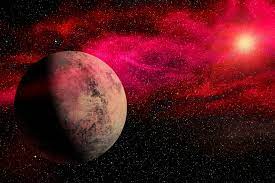
The Milky Way is home to a few stars similar to our familiar yellow, warm sun. The most common stars in our Galaxy are smaller, more relaxed, and have a mass that is only half of the sun’s. These familiar dwarf stars are orbited by billions of planets in our Galaxy.
To capture enough heat to be habitable, these planets must be very close to the tiny stars they orbit, making them vulnerable to extreme tidal forces.
University of Florida scientists have found that two-thirds of planets orbiting these tiny stars are likely to be sterilized by extreme tidal forces. One-third of worlds, hundreds of millions in the Galaxy, could be in orbit close enough and gentle enough to harbor liquid water.
The Proceedings of the National Academy of Sciences published the findings of UF astronomy Professor Sarah Ballard and her doctoral student Sheila Sagear on the 29th of May. Ballard and Sagear studied exoplanets for many years, the worlds that orbit other stars than our sun.
Sagear stated that this is a significant result for the next decade in exoplanets research because people are now looking at this population of stars. These stars are ideal targets for searching for minor planets in orbits where water is liquid; thus, the world could be habitable.
Sagear and Ballard determined the eccentricity for a sample of 150 planets orbiting these M dwarf stars that are roughly the size of Jupiter. The more oval-shaped an orbit is, the more eccentric. An eccentric orbit that is close to the star can cause tidal heat to occur. Mercury orbits around the sun at the same distance. Friction heats the planet as it is stretched and deformed due to changing gravitational force on its irregular orbit. This could lead to the earth being baked, eliminating any chance of liquid water.
Ballard stated, “it’s only these small stars where the zone of habitability can be close enough to make these tidal forces relevant.”
NASA’s Kepler Telescope captured the data, showing exoplanets moving before host stars. Ballard and Sagear measured the orbits of planets by focusing on the time it took for the worlds to cross the faces of their stars. The study also relied on data from the Gaia Telescope, which measured distances to billions of stars in the Galaxy.
Sagear stated that “the distance is the key piece of data we had been missing previously, which allows us to perform this analysis.”
Sagear and Ballard discovered that stars with more than one planet were most likely to possess the type of circular orbits which allow them to hold liquid water. The stars with just one world are the most likely to experience extreme tidal conditions that could sterilize their surface.
The Milky Way will likely have hundreds of millions more promising targets for searching for life beyond our solar system.