John “Tractor Ferguson” remembers being excited when the geothermal project in his small outback town cost several million dollars.
Residents of Thargomindah in Queensland, located about 1,000 km west of Brisbane, suffered frequent blackouts.
The state government funded the project in 2017 with $3.6 million. Its goal was to provide locals with cheap electricity.
Six years later, this project has failed, just like so many others scattered around the outback Queensland towns of Quilpie and Ilfracombe and Birdsville, Normanton, and Winton.
Locals such as Mr. Ferguson feel like they have “dodged bullets.”
The hot rock industry, once considered the unsung hero in renewable energy with the power to transform the sector, has been fading over the last decade.
Why does a mining company think that its project will be different?
Past mistakes can teach us valuable lessons.
Greenvale Energy, CeraPhi Energy, and others announced last month that they would be conducting a feasibility for a geothermal plant in Longreach (central-west Queensland).
The study, which will last 12 weeks, will determine whether or not the naturally heated underground wells in the region are suitable for a power station.
The project, if successful, would be the only geothermal plant operating in Australia.
Greenvale Energy had hoped that the plant would be operational by 2026.
Mark Turner, CEO of Greenvale Energy, said: “We are confident that we have the best technology. Once we start our plant, we expect many others to follow.”
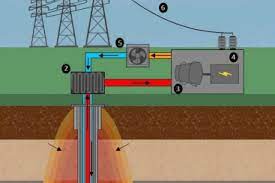
The project will utilize advanced geothermal technologies, which means that the technology won’t access underground water sources, like traditional geothermal plants, but will instead harness the energy of hot rocks.
“This means that there won’t be any losses. It will be a closed-loop system,” said Mr Turner.
Mr. Turner stated that the power generated would supply the township of Longreach, and any excess would be sent into the national grid.
He said the industry had learned lessons from the other projects mothballed in the region.
The Winton Shire Council took legal action last year against Peak Services, the commercial arm of the Local Government Association of Queensland, for the failure of a $4 million geothermal facility.
The plant was designed for 86-degree Celsius hot water to power the council buildings.
The plant never produced power after three years of construction and development.
After determining that they were not economically viable, the energy company Geodynamics 2016 closed down and cleaned up the sites of test wells and power plants in the Cooper Basin.
In 2018, Ergon Energy also “reluctantly” abandoned a geothermal plant in Birdsville in favor of solar distribution and storage.
Revival is on the Horizon
The potential of geothermal power is staggering.
Geoscience Australia, a government agency, estimated that 1% of geothermal energy in the country could provide 26,000 years’ worth of clean electricity.
The technology is successfully used in countries such as New Zealand, Indonesia, and Iceland.
In a rush to invest in renewable energy, state, and federal governments prefer solar and wind power over geothermal.