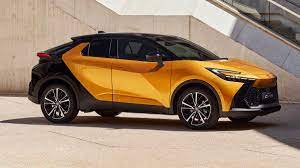
The new Toyota C-HR 2024 small SUV was unveiled before its first Australian showroom appearance early next year. It is exclusively powered by hybrid technology.
The second-generation C-HR is a more funkier version of the current model. The new Prius hatchback inspired it.
The first hybrid-only Toyota vehicle will be available in Australia during the first half of 2024.
Hybrid technology, including the C-HR, is available on 70% of Toyota models.
In Australia, there will be three models – the GXL with a 1.8-liter hybrid system with front-wheel-drive and the GR Sports flagship with a 2.0-liter hybrid with an all-wheel-drive.
The latest Prius heavily influence the new Toyota C-HR design. It features the same “hammerhead” front-end theme, C-shaped LED lights, and a sharp nose.
It’s no accident that the ‘Prius SUV styling’ is what it is. Early design mock-ups (released late last year by Toyota) suggested a front-end that now appears on the C-HR production with minimal changes.
The new C-HR, which was first shown in an electric concept vehicle 18 months earlier, ditches the ‘hidden door handles’ in the rear window panel of its predecessor in favor of pop-out handles similar to those on a Tesla Model 3 car.
The highlights include the ‘Toyota C-HR” illuminated letters between the tail lights and a two-tone paint finish that covers the majority of the rear end of the vehicle in black, with the doors and the front in the primary color. Wheel sizes are also available up to 19 inches in Australia and 20 inches overseas.
Top-of-the-range models have a 12.3” digital instrument cluster, rather than the futuristic 7.0” cluster set far from the Prius hatch driver. They also feature the Crown sedan’s steering wheel.
The infotainment screen measures 8.0 or 12 inches, compared to the 8.0-inch display of today. It runs Toyota’s newest software and features Apple CarPlay, Android Auto, satellite navigation via the internet, updates over-the-air, and voice assistance.
On flagship models, you can choose from a JBL Premium Sound System, Dual-Zone Climate Control Air Conditioning, Heated Front Seats and Steering Wheel, 64-colour Ambient Lighting, Wireless Phone Charging Pad, Surround-View Camera, and 64-colour Ambient Lighting.
Toyota claims the new CHR model uses twice as many recycled plastics as the previous one. This includes seat material made from recycled plastic bottles, resin bumpers claimed to be produced more efficiently, and over 100 other parts.
A new glass roof with “low-emissive, infra red-reducing coatings that keep heat inside” saves up to 5kg while allowing 3cm more headroom.
The GR Sport version has unique alloy wheels and metallic exterior trim. It also features a different grille pattern on the front; GR Sport badges inside and outside, GR headrest embossing and red interior accents, contrast stitching, and a GR steering wheel.
The C-HR GXL, and Koba, will be powered by a 1.8-liter 4-cylinder petrol engine (72kW/142Nm), an electric motor of 70kW/185Nm, and a lithium-ion pack that is claimed to deliver a combined 103kW, with front-wheel-drive.
The GR Sport will use a 2.0-liter engine with a higher output (112kW/190Nm), two similar electric motors, and a lithium-ion-based battery to achieve a system output of 145kW. It also has an all-wheel drive.
Europe will offer a plug-in hybrid model that combines the 2.0-liter petrol motor with electric motors and a larger pack of batteries. The capacity is not disclosed. This version will be sold outside of Australia.
The new C-HR will be based on the ‘TNGA C’ architecture used in the Prius, Corolla sedan and hatchback, Corolla Cross SUV, and other Toyota models.
The new C-HR is 4360mm in length, 1830mm in width, and 1558-1564mm high, with a 2640mm wheelbase. It’s 30mm shorter overall, 1-7mm lower, and has the same wheelbase as the old C-HR. However, it’s 35mm wider.