Last Wednesday, the NANOGrav Consortium of more than 190 scientists from over 70 institutions announced the detection of a predicted background of gravitational wave ripples across the fabric space-time. It is a great triumph for humanity, just like the first detection of the gravitational wave, made only eight years ago.
In 2015, the experimental discovery of gravitational waves focused on “high frequency” oscillations produced by compact objects that weighed around the mass and weight of heavy stars. Their periods it was ranged from fractions of a second to several seconds. This week’s announcement, which uses an entirely new technique, investigates a frequency range of waves with periods ranging from months to decades. It probes a different set of phenomena but confirms that the same physical principle is at work, that motion in the matter also causes space-time to ripple.
Albert Einstein’s Special Relativity and General Relativity theories laid the foundation for the NANOGrav discovery. The fact that such a large group and an enormous undertaking could be assembled confidently and brought to fruition validates physics’s materialist conception and achievements in the last two centuries.
To understand this week’s announcement, it is necessary to take a brief detour into the background of gravitational wave research. Einstein took the idea of Nicolaus Copernicus (1473-1543) that the Earth is not the center of the Universe to its logical conclusion: he extended and modified the immensely successful physical theories developed by Isaac Newton (1642-1727) so that there was no or specific “center” from which physical laws were derived. To achieve unification, he needed to integrate time in a fundamentally different way into the mathematical fabric that was used for the laws of motion. In his General Relativity of 1919, he also incorporated curvature into this fabric to describe the action of objects under the influence of gravitation.
General Relativity can be summarized as follows: Matter tells space to bend, and the play tells bent matter to move. Behind this simple explanation are complex mathematical equations and predictions that were once considered so exotic by some they could only be an exercise in pure thinking.
Astronomy and general Relativity
Einstein’s theory, and the introduction of Quantum Mechanics as a new physical law, profoundly impacted astronomy. By 1914, a new object class called the “white dwarf” had already pushed physical concepts based on previous knowledge to their limit. Arthur Eddington wrote in Stars and Atoms from 1927 that:
Subrahmanyan Chandrasekhar would only work out three years later, in 1930, the physical nature of these “white dwarf” stars, using Relativity and Quantum Mechanics. He also derived a limit for their mass. Four years later, more exotic objects were hypothesized.
Ernest Rutherford’s discovery of the nucleus of an atom in 1906 revealed that the majority of mass in a bit is contained in the very compact core and that the vast majority of the atom is space. Rutherford fired high-speed alpha particles (helium atoms) at a thin gold foil. The majority of the helium atoms passed through with little or no deviation. Rutherford later recalled that the event was “quite incredible for some.” It was like firing a 15-inch round at a piece of tissue paper and then having it come back and hit you. These alpha particles made only rare hits on the gold nucleus. They bounced back to reveal the concentration of mass within the atom. The fact that most alpha particles passed through unaffected revealed the presence of space within the bit.
Fritz Zwicky hypothesized an even more exotic object in 1934: the “neutron-star” (just two years after discovering the particle that bore its name), where the space between atoms is eliminated, and the star’s density equals the atomic nucleus. The thickness of the lead was not just 3,000 times greater than that of anything normal but another millionfold more so that a teaspoon’s volume had a mass similar to Mount Everest. By the end of that decade, the first calculations on the structure and limits of such stars had been made. Zwicky correctly predicted that the supernovae explosions would require energies and density from which exotic objects might emerge. However, they were still waiting for immediate prospects for their detection.
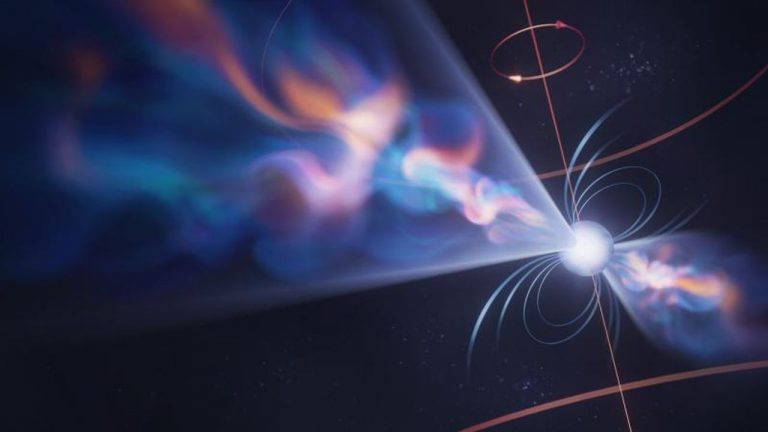
Astronomy continued to advance. As the telescopes expanded from visible light to longer wavelengths in radio (and then to all wavelengths on the electromagnetic spectrum), one of the fruits of this work was the discovery of unknown radio sources, which chirped with fantastic precision. These radio sources would become known as “pulsars.”