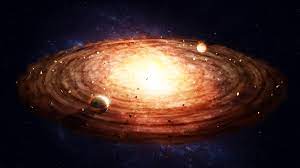
Old stars moving through regions where new stars are forming could be the source of a radioactive heating source, which may be vital for young planets.
This discovery shows that older stars traveling through star-forming regions could be a source of radioactive elements for developing solar systems. These elements are required to heat the interiors and surfaces of newborn planets.
This heat could have even indirectly contributed to the plate tectonics that helps maintain a breathable environment on Earth.
Today, the study by scientists from Imperial College London and the University of Sheffield was published in Astrophysics Journal letters.
Heat source
Asymptotic Giant Branch stars (AGB stars), old-evolved stars, emit large quantities of radioactive elements. These include Aluminium-26 and Iron-60. These elements were known to have been a source of heat in the early Solar System when the Earth formed.
It was assumed that nearby massive stars formed these elements. The radiation from these AGB stars is so intense it’s thought that they could stop planets from forming.
This new study describes observing an AGB star passing through a region of young stars forming. It presents a more viable method of providing these radioactive materials.
Lead author Professor Richard Parker from the University of Sheffield said: “AGB stars have long been known as a source of Iron-60 and Aluminium-26, but researchers were skeptical until now that these old evolved stars would ever encounter young stars that are creating planets.
By showing that AGB star systems can meet young planets, we have shown other sources of Aluminium 26 and Iron 60, such as winds and supernovas of very massive stars, are not required to explain these chemical elements’ origin in our Solar System.
Serendipity and science
The team found the AGB star by using the Gaia Satellite. This EUR740m European Space Agency project maps the positions of billions of stars in our galaxy. Researchers could pinpoint interloping (or passing) stars using the latest Gaia data release, Data Release 3.
The star was discovered in the star-forming region NGC2264, which contains the Cone Nebula and the Christmas Tree Cluster. It is located approximately 2,500 lightyears away.
Researchers calculated that a star similar to our Sun could capture as much Aluminium-26 and Iron-60 (from the AGB) when it formed planets.
Dr. Christina Schoettler, from the Department of Physics, Imperial College London, identified the AGB stars in the Gaia DR3 Data. She said: “Gaia revolutionises our ideas about the formation of stars and their subsequent movement in the galaxy.” This discovery of a young, planet-forming star near an older, evolved one is an excellent example of how serendipity can be used in scientific research.