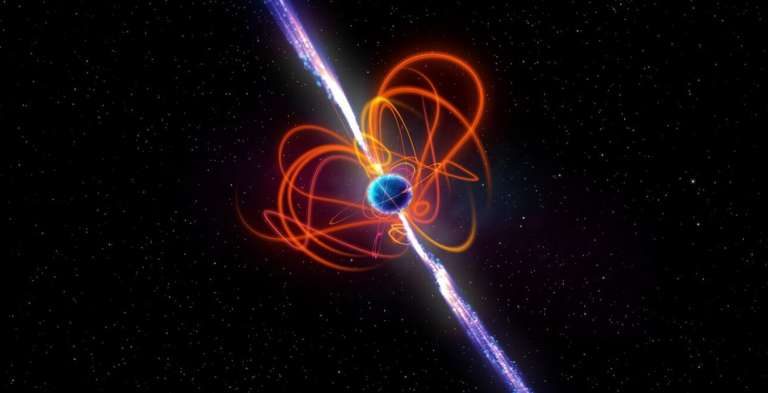
Astronomers are expecting to see repeating radio waves in space. However, they blink on and off more rapidly. Most of the time, repeating radio signals are caused by pulsars. Pulsars are rotating Neutron Stars which emit energetic beams similar to lighthouses. They blink on and off when they turn away and towards Earth.
As they age, pulses get weaker and eventually stop emitting radio waves. The slowness of our pulsar is best explained by a magnetar, a pulsar with a highly complex and powerful magnetic field. It could produce radio waves for months before it stopped.
We detected the source based on data collected in 2018. When we finally analyzed our data in 2020 and found what we believed to be a magnetar, it had stopped producing radio waves. We were only able to test our magnetar hypothesis with additional data.
There is nothing new under the Sun.
We live in a vast universe, and every new phenomenon we have discovered is not unique. We knew we could find another radio source with well-designed observation if we looked at it again.
We used the Murchison Widefield Array Radio Telescope in Western Australia for several months to scan our Milky Way Galaxy every three nights.
We didn’t have to wait very long. We found the source almost immediately. It was in a completely different area of the sky. This time, it repeated every 22 minutes.
Finally, we got the moment that we had been looking forward to. We made as many observations with every telescope, including radio, optical, and X-ray light. Assuming it would be active only briefly, we used as many as possible. Each pulse lasted for five minutes, with a gap of 17 minutes in between. The object was similar to a pulsar but spun 1,000 times slower.
Hiding in plain sight
We were surprised by the results when we searched for the oldest radio recordings of this region of the sky. The Very Large Array, located in New Mexico (United States), holds the most extended archive of data. The oldest pulse was found in 1988, but we could see it in every year of data.
We could precisely time the pulses by observing them over three decades. Every 1,318.1957, plus or minus a tenth millisecond, the source produces them.
Selon our current theories, if the source produces radio waves, it should be slowed down. According to observations, this is not the case.
Our Nature article demonstrates that the source is “below the death line,” which is the theoretical limit for how neutron stars can generate Radio waves. This holds even for models with complex magnetic fields. The radio emission from a magnetar should be visible only for a few years or months, not 33 years.
What is ET?
It’s tempting to think of extraterrestrial intelligence at this stage. When pulsars first appeared, the same thing happened: Astrophysicist Jocelyn Bell Burnell and her colleagues discovered the first pulsar and nicknamed it LGM 1 for “Little Green Men 1.”
Bell and her co-workers knew it was not aliens as soon as they made more detections. It is doubtful that so many signals similar could be coming from different parts of our sky.
Like natural radio sources, the pulses were similar to our start in that they contained no information. They only “noise.” Energy Requirements for a Signal at All Frequencies are also staggering. It would help if you used a neutron star.
Using this method to explain a phenomenon is tempting, but there are better ways. This approach does not encourage us to continue thinking, observing, and testing new ideas. It’s the ” aliens in the gaps ” approach.
This source is still in operation, and anyone can see it. We can solve this cosmic mystery with more creative observations and analysis.