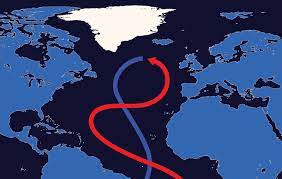
If greenhouse gas emissions continue, critical ocean currents which redistribute temperature, precipitation, and cold between the tropics of the Atlantic and northernmost parts will cease to exist around 2060. New calculations by the University of Copenhagen contradict the IPCC’s latest report.
Climate change may have a more negative impact on Europe than we think. Researchers from the Niels Bohr Institute at the University of Copenhagen and the Department of Mathematical Sciences have published a study that predicts the end of the ocean current system, which distributes heat and cold between the North Atlantic and the tropics.
The researchers used advanced statistical tools to analyze ocean temperature data for 150 years. They calculated that, with 95% certainty, the Atlantic Meridional Overturning Circulation, or AMOC, will collapse between 2025-2095. The collapse will occur most likely in 34 years or 2057. This could cause significant problems, including increased storminess and warming in the North Atlantic.
Shutting down the AMOC could have severe effects on Earth’s climate. For example, it can change how heat and rain are distributed around the globe. This shutdown will increase the warming in the tropics, where the rising temperatures are already causing difficult living conditions.
The researcher says, “Our result highlights the importance of reducing greenhouse gas emissions worldwide as soon as possible.”
The calculations published by the renowned journal Nature Communications contradict the IPCC’s latest report. Based on climate model simulations, the IPCC considers a sudden change in thermohaline circulation improbable in this century.
Early warning signs are present.
Researchers’ predictions are based on early warning signs that ocean currents display as they become unstable. The Early Warning Signals of Thermohaline circulation have been previously reported. Still, it is only with the advent of advanced statistical techniques that we can now predict when the collapse will occur.
- The Atlantic Meridional Overturning Circulation is part of the global system of ocean currents. It is responsible for the most significant heat redistribution between the tropics and the northernmost areas of the Atlantic region, including Western Europe.
- The circulation at the northernmost latitudes ensures that ocean currents are converted from surface water to deep currents moving southward. This transformation allows more surface water from the equatorial region to be transported northward. The thermohaline circulation plays a crucial role in maintaining the mild climate of the North Atlantic.
Researchers analyzed sea surface temperature in a particular area of the North Atlantic between 1870 and today. These sea surface temperature “fingerprints,” which only have been measured for the last 15 years, are a testament to the strength of AMOC.
We could not estimate the likelihood of a Thermohaline circulation collapse before, but we have now been able to calculate it using new statistical tools. Professor Susanne DITLEVSEN of UCPH’s Department of Mathematical Sciences explains.
Since the last ice age, the thermohaline circulation has been in its current state. In connection with the ice age climate, 25 abrupt climate jumps have been observed between the current state of the AMOC to the collapsed state. The famous Dansgaard and Oeschger events were first detected in the ice cores of the Greenlandic Ice Sheet. Climate changes at those times were extreme, with 10-15 degrees changes over a ten-year period. Today’s climate changes are 1.5 degrees over a hundred years.
The study is:
TiPES is a joint European research collaboration that focuses on the tipping point of the climate system. The TiPES climate research project is an EU Horizon 2020 inter-disciplinary climate project focusing on tipping points within the climate system.