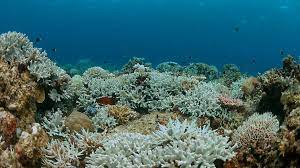
Scientists have used new photographic technology to peer beneath the ocean’s surface to see the hidden worlds of baby corals. They can now learn more about how these tiny organisms grow and survive in the crucial first year of their life.
Researchers from Southern Cross University, CSIRO, and the Australian Institute of Marine Science describe how advanced imaging techniques can be used to monitor baby corals in a new study that was just published.
Corals are vital habitats for many marine species. Understanding how coral baby colonies attach themselves to reefs, establish themselves, and then grow into adult corals is essential.
This knowledge is essential if you want to help the reefs recover after devastating events like mass bleaching or cyclones.
Corals: the secret life
Corals begin their life in synchronized annual spawning. Coral colonies release millions at once of tiny eggs and sperm. All of them rise to the surface, where they are fertilized and develop into embryos, then larvae.
The ocean currents disperse millions of larvae over days or even weeks. If all goes according to plan, the larvae will eventually fall into the water and attach to a coral reef. They will then grow to adult size. This is called the “recruitment” of corals.
This recruitment happens naturally in healthy coral reefs. As coral reefs degrade – for example, through coral bleaching caused by climate change – fewer coral larvae are produced. This can lead to a slowdown or halt in recruitment and a weakening of natural recovery.
Scientists are looking for ways to attach coral larvae to reefs and ensure they grow there. Scientists are working on ways to ensure coral larvae connect and expand on reefs.
The coral larvae are smaller than 1 millimeter, so the recruitment process is invisible to humans. Researchers have traditionally attached artificial plates on the reef to better understand the process. After the corals have grown, the leaves will be taken to the laboratory to be examined under a magnifying glass.
The reef captured in stunning 3D detail
Our new study explores developing and applying an innovative imaging approach known as underwater “macro photogrammetry.”
This technology combines photogrammetry with macro photography, which measures photos taken at high resolution. Photogrammetry stitched together images to create a three-dimensional model like the one below.
We placed three “targets” in the model to help the software combine the photos. You’ll notice a nail head on the left side of each target if you look closely. The nail head measures 2.8mm. This will give you a sense of scale.
Reef-scale photogrammetry helps track changes in coral growth and cover over time. It does not have the resolution required to observe and identify tiny new corals.
This incredible scale is provided by macro photography. This coupling also allows a comprehensive ecosystem view from the smallest to the most significant processes.
We conducted a macro photogrammetry survey near Lizard Island on the Great Barrier Reef. We marked 25cm by 25cm on the reef. We took hundreds of photos from different angles with high-resolution digital cameras.
The photos were processed using photogrammetry software to create 3D models of the reef in high-resolution small sections.
They were examined to determine where coral larvae settle, mark their location, and measure their size. The models reveal the microstructure of the reef, including the tiny crevices where coral larvae are often found.
Models also reveal microorganisms, such as invertebrates or tiny turf algae, interacting with corals when recruited.
Look ahead
Complementary methods may enhance the capabilities of macro photogrammetry. Before release, coral larvae could be dyed in various colors to make them more visible as they swim and settle onto the reef. It could be captured on 3D models to understand the larval restoration effort better.
Macrophotogrammetry can help us better understand why some larvae survive and settle on coral reefs while others don’t. This knowledge will support our efforts to improve the overall conservation of coral reefs.