Southern Cross University and CSIRO have successfully used underwater macro photogrammetry to closely monitor newly established corals on the Great Barrier Reef at the submillimeter scale.
A team of scientists from Southern Cross University, CSIRO, and the Journal Methods in Ecology and Evolution demonstrates how advanced imaging techniques offer new opportunities for monitoring and studying the recruitment of corals and other sessile organisms (attached), at an excellent scale, directly on the reef.
This method is beneficial for monitoring the success of recruitment of newly established corals after coral larval restoration interventions when microscopic larvae are raised in floating coral nurseries and released in mass on reefs damaged due to the effects of climate change.
Marine Gouezo is the lead researcher and a Post-Doctoral Scientist at Southern Cross University.
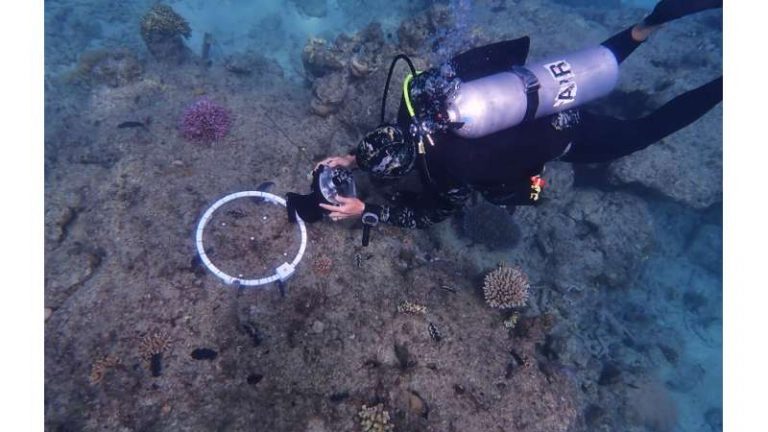
This new method allows for the documentation and tracking of recruitment in the natural habitat of corals that are 0.5 millimeters in size. The study shows the application of underwater photogrammetry. This combines macro photography, which involves taking high-resolution photos to see tiny organisms, typically smaller than 1 mm, and photogrammetry.
This innovative approach is superior to traditional methods of observation in the field, which rely on artificial devices like tiles. It allows scientists to monitor the settlement and recruitment of larvae on a coral reef.
While reef scale photogrammetry has been used for years in underwater ecological surveys, particularly during monitoring programs, to document changes over time, such as coral coverage, it does not have the resolution needed to see baby corals. The macro photogrammetry technique complements reef scale photogrammetry by magnifying a small portion of the reefs to monitor the coral reef at the submillimetre scale.
The macro photogrammetry method is cost-effective for large-scale projects such as Coral Larval Restoration at the Great Barrier Reef. It also eliminates the need to install equipment on the reef and access laboratory microscopes. It creates a three-dimensional (3D), permanent record of small reef areas that characterizes reef-associated organisms and their natural environments.
Advances in modern photography, underwater cameras, and software for 3D reconstruction have revolutionized coral reef research. Digitizing the monitoring step can lead to automated processing and machine-learning techniques.
The macro photogrammetry technique provides researchers with an approach that allows them to monitor marine life in unprecedented detail. “I am excited by its potential to propel marine ecological research and restore efforts forward,” said Dr. Gouezo.
Dr. Gouezo, a Senior Research Scientist at CSIRO Environment and a Southern Cross University’s Coral Larval Restoration Team member led by Professor Peter Harrison (who also wrote the paper) is credited as ‘the author. Dr. Christopher Doropoulos is a Senior Scientist at CSIRO Environment and a co-author.
The macro photogrammetry method allows us to examine coral recruitment at the earliest stages in the field for the first time instead of using proxy measures such as settlement tiles,” explained Dr. Doropoulos.
It will improve our understanding of the ecological factors that limit and promote successful larval settlement and early survival. This will allow us to optimize the scale and application of coral restoration operations based on larvae.
Cedric Robert, Executive Director of the Great Barrier Reef Foundation and RRAP, said: “Photogrammetry techniques like these are being developed throughout the RRAP to help us close critical knowledge gaps in Reef Recovery.”
It’s an essential first step in developing and testing novel scientific solutions that managers can use to help the Great Barrier Reef and other coral Reefs survive the effects of climate change.