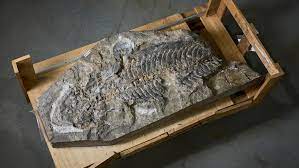
Arenaepeton Supinatus was almost forgotten in a retaining wall.
It was only by accident that a nearly perfectly preserved fossil of a prehistoric 1.5-meter meter amphibian was found on the Central Coast, north of Sydney, almost 30 years ago.
The retired chicken farmer Mihail Mihailidis was lucky to have taken a closer view of the slab of sandstone that he had bought for a renovation project in his backyard.
He turned it over and saw the curious creature’s imprint.
Lachlan Hart, a paleontologist, says: “It’s a rare and amazing find.”
As a 12-year-old dinosaur enthusiast, Mr. Hart was the first to see the 240 million-year-old specimen. After receiving significant international press, the fossil was displayed in Sydney after Mihail donated it to science.
It ended up in storage again without anyone ever formally identifying it.
Last year, Mr. Hart and his Australian Museum colleagues took the fossil from the archives and began to look into it.
“My mind blew,” Mr. Hart says.
“It was my personal connection with it and that no one had worked on it for 25 years.
In paleontology, it’s rare to find fossils with head and body skeletons attached.
This one has remnants of fat and skin.
The team identified the ancient creature by its order of ancient amphibious carnivores and gave it a formal name.
“Arenaepeton is a sand creeper in Latin,” says Mr. Hart.
The fossils are lying backward, so the word supinatus is used.
It is thought that the Triassic-era creature hunted its aquatic prey using tusks like fangs and may have webbed feet.
The fact that it is not picky about food could be why it survived two mass extinctions.