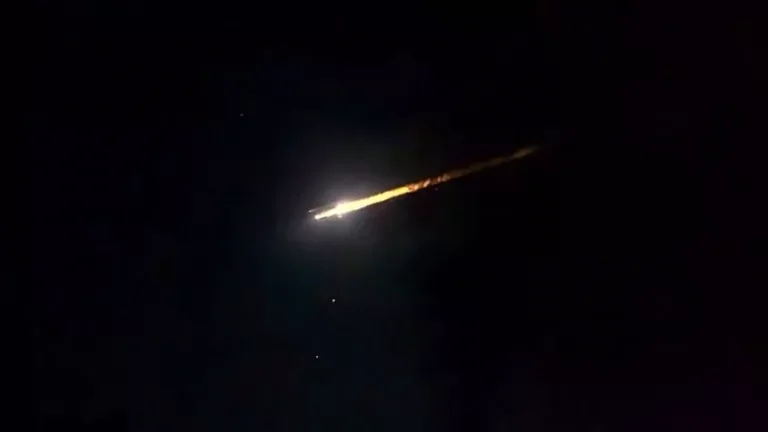
On Monday night (August 7), a Russian rocket body fell to Earth near southern Australia, putting on a spectacular show for those in the area.
7 News Australia reported via X on Tuesday, August 8, that the crashing rocket created a “fireball” and a sonic bang, which shook homes in Victoria, Australia’s second-largest city.
According to astrophysicist Jonathan McDowell, the chunk of junk had only been in orbit for a short time. The third stage of a Soyuz launch launched a Glonass satellite earlier that day.
McDowell reported that the third stage of Soyuz reentered Earth’s atmosphere southeast of Tasmania over the open ocean around 10 am EDT (1400 GMT, midnight Melbourne time).
(We would probably consider the fallen body the Soyuz rocket’s second stage, but Russian space officials count the strap-on boosters as its first stage, McDowell noted in a data-component tracked=”1″ data URL=”https://twitter.com/planet4589/status/1688729066440949760″>another social media post/a>. McDowell pointed out that Russian officials counted the strap-on boosters of the rocket as its first stage.
Michael Brown, associate professor at the School of Physics and Astronomy of Monash University, Melbourne, stated that the Soyuz stage entered the atmosphere traveling several kilometers per second.
In an email about the event, Brown stated that “space junk reentries can be confused with Meteors which are spectacular, but usually shorter events as they slammed into the atmosphere much faster.”
He added that it is rare for space debris to cause property damage.