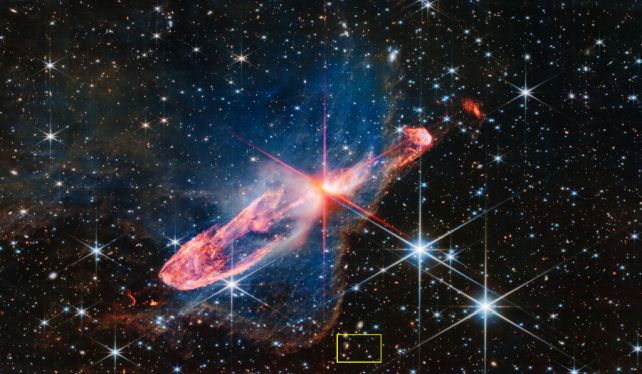
You might be surprised if you zoom in on a fantastic new James Webb Space Telescope image.
In the backdrop of the spectacular star birth, there is a curlicue of light and blob in English punctuation: the question mark.
The object’s exact nature is not known, but it is relatively far away. The more red an object appears on a field image, the farther the thing is. The accelerating expansion causes light to be stretched as it moves toward us. This results in the reddish parts of the spectrum. Two distant galaxies could interact if the two blobs have the same hue. We see this phenomenon quite often in the Universe. The gravitational interaction can cause galaxies to take on unusual, elongated forms. Some of them look like other objects. The Antenne Galaxies looks like a mirrored Bass Clef.
Arp-Madore 2026-424 is a skull .
It’s not that they are, but rather a peculiarity of human perception called pareidolia. This is when we perceive patterns and meanings in seemingly random arrangements of elements.
The cosmic question mark may look different up close. We may have the right combination of distances and perspectives to make both objects appear as something to us.
We’d choose the question mark as the mascot of the Universe. There has never been an object that sums up so perfectly our endless curiosity about the boundless realms of space above.