NASA’s James Webb Space Telescope followed up on Hubble Space Telescope observations of the furthest star in the universe. This was within the first billion after the big bang. Webb’s NIRCam instrument (Near-Infrared Camera) reveals that the lead is a massive B-type, more than twice hotter and a million times more luminous.
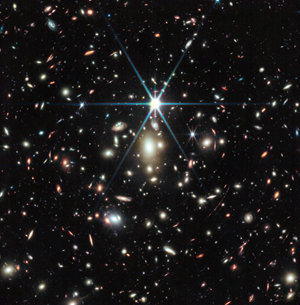
Hubble and Webb detected Earendel due to its alignment behind the wrinkle created in space-time by the massive galaxy WHL0137-8. This galaxy cluster is located between us and Earendel. It’s so huge it bends space, creating a magnifying effect. Hubble and Webb were able to detect Earendel due to its lucky alignment behind a wrinkle in space-time created by the massive galaxy cluster WHL0137-08.
In Webb’s high-resolution infrared images, Earendel appears only as a single light point. Other features of the galaxy are magnified multiple times by gravitational lenses. This allows astronomers to determine that the object has been magnified at least by 4,000 and is extremely small. It is the most distant star detected 1 billion years after the big bang. Hubble held the record for the most distant stars, observed 4 billion years after the big bang. A research team used Webb to identify a gravitationally-lensing star named Quyllur. This red giant star was observed 3 billion years after the big hit.
Even massive stars like Earendel have companions. Astronomers didn’t expect Webb would reveal any Earendel companions since they were so close and indistinguishable. Based solely on Earendel’s colors, astronomers believe they can detect hints of a redder, more excellent companion star. The expansion of the cosmos has stretched this light to wavelengths that Hubble’s instruments cannot see. This was the only way Webb could detect it.
Webb’s NIRCam instrument (Near Infrared Camera) reveals that the star nicknamed Earendel is a massive B-type star. It is twice as hotter and a million more luminous than our Sun.
Credits: Image NASA, ESA, and CSA. D. Coe, STScI/AURA (for ESA) at Johns Hopkins University. B. Welch, NASA’s Goddard Space Flight Center, University of Maryland College Park. Image processing: Z. Levay.
Webb’s NIRCam shows more details of the Sunrise Arc. This is the most giant galaxy ever detected within the universe’s first billion years. The features include young star-forming areas and older star clusters as small as 10 Light-Years in diameter. The distortion of the gravitational lenses is mirrored on either side of Earendel’s wrinkle of maximum magnificence. The region where stars are formed is estimated to be less than five million years old. Two smaller dots, one on either side, show two images of an older star cluster estimated to be 10 million years old. Astronomers have determined that this star cluster will likely persist into the future due to its gravitational ties. This is how the globular clusters of our Milky Way may have appeared when they were formed 13 billion years ago.
Astronomers have been analyzing the data collected by Webb’s NIRSpec instrument, which is used to observe the Sunrise Arc Galaxy and Earendel. This will allow them to determine the galaxy’s composition and its distance.
Using the same technique Hubble used to discover Earendel, Webb found other stars far away but none as distant as Earendel. These discoveries have given scientists a whole new perspective on the early universe. Previously, galaxies, the most miniature cosmic objects, were the only ones that could be detected. Researchers are cautiously optimistic that the discovery could lead to the detection of one of the first stars created from the original ingredients of the universe, hydrogen, and helium.