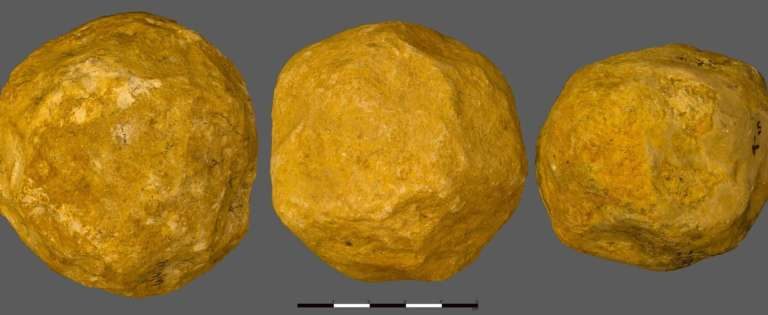
Archaeologists have been puzzled by limestone spheroids for many years. The purpose of their creation is still a matter of intense debate, even though they range from the Oldowan period to the Middle Paleolithic.
A study by the Computational Archaeology Laboratory of the Hebrew University of Jerusalem in collaboration with Tel Hai College researchers and Rovira I Virgili University researchers aims to shed some light on these mysterious items, providing insights into the intentions of early hominins.
Spheroids, often considered the by-products of percussive activities, are some of the oldest and least understood archeological artifacts. The team’s research, however, challenges this conventional wisdom. This study’s central question is whether the spheroids are unintentional products or tools intentionally designed to serve specific purposes.
To answer this question, advanced 3D analysis techniques, such as spherical harmony and surface curvature, were applied to 150 limestone spheroids dating from approximately 1.4 million years ago at the ‘Ubeidiya archaeological site. The Computational Archaeology Laboratory developed these methods at the Hebrew University under the direction of Professor Leore Grosman.
The earliest Acheulean site outside of Africa is now recognized as ‘Ubeidiya, making it an important location to investigate the evolution of early Hominin Technology.
The team of researchers meticulously reconstructed a spheroid sequence using the geometrical and scar facet patterns. Their findings revealed a striking design: The spheroids found at ‘Ubeidiya had been crafted using a deliberate reduction strategy.
Contrary to popular belief, spheroids were not smoothed out during production. Instead, they became more spherical. This transformation into an ideal sphere took exceptional knapping skills and a preconceived goal.
This discovery challenges beliefs about early hominins’ capabilities and their relationship to technology. The Acheulean Bifaces have traditionally been thought to be the earliest evidence that hominins imposed intentional, symmetrical forms on stone. However, the deliberate production at ‘Ubeidiya of spheres-like objects suggests the same thing. These early hominins were motivated by and achieved intentional geometry and symmetry.
There are slightly older spheroids at sites in Africa. This would be the oldest example of hominins attempting to achieve symmetrical stone shapes.
The team’s research opens up new ways to understand our distant relatives’ cognitive capabilities and technical achievements. The study raises further questions regarding the function and significance of the spheroids to early hominins.