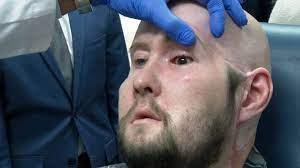
US surgeons performed the first-ever transplant of an entire eye. This is an incredible addition to a facial transplant. However, it’s too early to tell if this man will be able to see with his new left eye.
Aaron James lost his right eye and most of his face in an accident involving high-voltage electricity lines. The right eye is still functional. The surgeons at New York University Langone Health wanted to replace the missing eye in order to achieve better cosmetic results on his new face by supporting the newly transplanted lid and socket.
NYU announced that it has done so far. James is doing well after the double transplant in May, and the eye donated looks healthy.
I feel good. It still doesn’t move. My eyelid, I can’t blink yet. James said to The Associated Press that he was now feeling sensations.
James, 46, from Hot Springs, Arkansas, added, “You have to start somewhere. There has to be someone who is the first.” It may teach you something that can help the next person.
Transplants of corneal tissue — the transparent tissue that covers the front of the eyes — are now common for treating certain forms of vision loss. The whole look, including the blood supply to the eye and the optic nerve that connects the eye to the brain, is a moonshot for the cure of blindness.
We don’t claim that we will restore sight”, said Dr Eduardo Rodriguez of NYU, the plastic surgery chief who led the operation.
I am certain that we have made progress.
Some doctors feared that the eye would soon shrivel up like a raisin. When Rodriguez propped James’ left eyelid open last month, the hazel-colored donated look was just as plump and as full of fluids as his blue eye. Doctors report good blood flow with no signs of rejection.
Researchers have now begun analyzing scans taken of James’ brain, which detected some puzzling signs from the important but injured optic nervous.
A scientist who has studied eye transplants for many years called the surgery “exciting.”
“It’s amazing validation” that animal experiments have kept transplanted eyes alive, Dr Jeffrey Goldberg, chair of Ophthalmology at Stanford University.
Goldberg said that the challenge is to regrow an optic nerve. Animal studies have made progress, but Goldberg noted that there are still challenges. Goldberg praised the NYU’s “audacity,” in attempting to repair the optic nerve and hoped that the transplant would spur more research.
Goldberg stated, “We are really on the brink of being able do this.”
James was working in June 2021 for a company that installed power lines when he was shocked. He nearly died. He eventually lost his left hand and needed a prosthetic. The left eye had become so painful that it was removed. Multiple reconstructive surgery could not repair his extensive facial injuries, including the missing lips and nose.
James endured physical therapy for several months until he felt strong enough to accompany his daughter Allie while wearing a mask and an eye patch to the high school homecoming. He still needed feeding and breathing tubes and longed for the ability to taste, smell, and eat solid foods again.
“In his head and heart, it was him. So, I didn’t really care that he didn’t have a nostril. Meagan, his wife, said that she cared about the fact that it made him uncomfortable.
Face transplants are rare and dangerous. James’ face transplant is the 19th to be performed in the US and the fifth that Rodriguez has done. The eye experiment was even more complex. James thought he wouldn’t be worse off even if the eye donation failed.
James was put on a national waiting list for a transplant three months ago. A matching donor was then found. The kidneys, liver, and pancreas of the donor saved three other people.
The surgeons who performed James’ 21-hour surgery added an experimental twist. When they joined the donated optic nerve to the remnants of James’ original, the stem cells of the donor were injected in the hope of promoting its repair.
Last month, tingles were a sign of healing facial nerves. James is unable to open his eyelid and uses a patch on it. As Rodriguez pressed on the closed eyelid, James felt a sensation – although it was on his nose and not his eyelid. This is until the slow-growing nervous system gets reoriented. The surgeon detected small movements in the muscles surrounding the eye.
Next, a closer inspection was conducted. NYU ophthalmologist Dr Vaidehi Dedania ran a series of tests. She found the expected damage to the retina that detects light at the back of the eyes. She said that it appeared to have enough photoreceptors, which are special cells used to convert sunlight into electrical signals. This is one of the steps in creating a vision.
Normally, the optic nerve would then send these signals to the cerebral cortex to be translated. James’ optic nerve has not healed. When the light was flashed in the donated eye, an MRI recorded some brain signaling.
The researchers were both intrigued and puzzled by this, even though it was not the correct type of retinal cell for vision. It may be just a fluke. Dr Steven Galetta is NYU’s chair in neurology. Time and further study will tell.
The surgery is still “a technical tour-de-force,” said Dr David Klassen. He is the chief medical officer for the United Network for Organ Sharing, which manages the nation’s organ transplant system. You can learn a lot from one single transplant that could help advance the field.