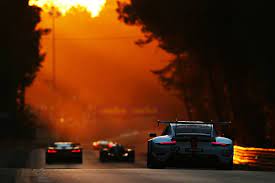
It was 100 years ago a cultural icon in motorsport began.
May 26, 1923, was the date of the inaugural 24 Hours of Le Mans — an event that has become the cornerstone of endurance motor racing.
The annual race has gone through every phase of motor racing over the past century, from revolutionary cars to constant improvements in safety.
The first race was held from May 26-27, 1923, and was an immediate success.
The showcase of automobiles was a spectacle, with 30 cars making it to the finish.
Andre Lagache and Rene Leonard won the first 24 Hours of Le Mans, driving the Chenard & Walker entrant.
It would take seven years before the now-famous race had its first female driver.
In 1930, two female racers tackled Le Mans — Odette Siko and Marguerite Mareuse.
The pair teamed up in the 1.5-liter engine category, driving a Bugatti T40.
They finished seventh overall, completing 128 laps.
Siko’s best performance would come in 1932 when she teamed with Louis Charavel to win the 2-liter class and finish fourth overall.
The race grew in popularity over the next decade.
However, the race would take a 10-year hiatus in 1939.
The outbreak of World War II brought an end to the event. The circuit underwent a significant upgrade following the war and resumed its famous race in 1949.
The return of the endurance classic was again a hit, but tragedy would strike the event in 1955.
French driver Pierre Levegh was involved in an accident that claimed his life and the lives of more than 80 spectators.
Around a further 180 were also injured.
Levegh was involved in a crash that sent his Mercedes to the edge of the track. His car jumped over the protective barrier and plowed into spectators.
The car exploded into flames while debris flew into the crowd.
The disaster prompted a major overhaul to safety.
The race still attracted thousands of fans despite the disaster in 1955.
Its prominence in motorsport grew through the 50s and 60s as racing became a larger entity.
While the race is at the epicenter of French motorsport, it is Germany’s manufacturers who have been the masters of Le Mans.
Porsche has won the race 19 times, while Audi is the second-best manufacturer with 13 victories.
Ferrari has taken the overall honors nine times, while Toyota is the most successful Asian entrant with five wins.
All five of Toyota’s wins have come in the last five races from 2018-2022, making them the dominant force of the modern era.
Toyota thought their first win was coming in 2016, but the car driven by Kazuki Nakajima broke down with 3 minutes left in the race.
Before Toyota’s dominance, Mazda was the only Asian manufacturer to win at Le Mans — achieving their lone win in 1991.
Danish driver Tom Kristensen is the undisputed king of Le Mans, winning the race nine times.
He won six consecutive races from 2000-2005.
He is three wins clear of legend Jacky Ickx, who once held the record at six.
This year’s race will be held on Sunday, June 11, starting at midnight AEST.
This year’s race will be the 91st, with 16 entrants in the top-tier hypercar class.