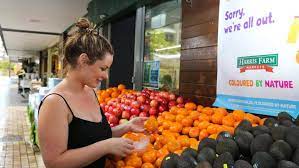
Despite cost-of-living pressures, Australians spend big on cafes and takeaway food, which have held down retail Spending.
On Friday, the Australian Bureau of Statistics revealed that food spending was up 13% year-on-year, despite a slight drop in the last months.
The first drop in sales in 13 months, the $12.4 million in April at the takeaway and restaurant outlets, is only 0.02 percent of the total $5.25 billion spent.
The agency’s monthly retail report, which shows that spending on goods and services continued to decline in 2023, also revealed the revelation.
Ben Dorber, ABS’s head of retail statistics, said that the slowdown of retail Spending since the beginning of the year has continued into April.
Mr. Dorber stated, “Retail turnover plateaued in the last six months as consumers reduced their discretionary spending due to rising interest rates and cost of living pressures.”
The Spending was soft again in April but was boosted by an increase in winter clothing purchases in response to the cooler and wetter-than-average weather in many parts of the country.
The modest decline in food-related expenditures comes after a sustained period of growth, primarily driven by food inflation. The return of major sporting and cultural events has also boosted Spending.
Australians spent over $35 billion total in April 2023 compared to less than $30 billion during the same month in 2018.
Spending on cafes, restaurants, and clothing was $5 billion, while department stores and apparel were $3 billion and $1.9 billion, respectively.
The results were mixed in all the states and territories, with four drops and three increases. However, the Northern Territory was unchanged.
Tasmania reported the most significant drop in sales, with a 1.5 percent decline, followed by NSW, Victoria, and ACT.
The most significant increase was in Western Australia, which recorded a 1% rise. Smaller increases followed this in QLD and South Australia.
Mr. Dorber stated that “turnover has reached a record high in South Australia after three consecutive increases of 0.6%”.