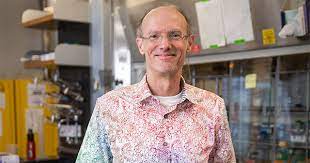
Grinstaff, a world-renowned inventor and researcher who is also a chemist at Boston University, won the Royal Society of Chemistry Centenary Prize for “recognition of brilliance and innovation in research and development.” Grinstaff was named the University’s first Distinguished Professor of Translational Research.
The Royal Society of Chemistry was founded in the United Kingdom in 1841. It has over 54,000 members worldwide and is a nonprofit publication arm. Previous award winners are said to have won 60 Nobel Prizes. According to the website, “outstanding communicators and chemists from abroad” are eligible for the Centenary Award. Grinstaff and two other award winners will be traveling to the British Isles to deliver a series of lectures.
Grinstaff heads the BU Nanotechnology Innovation Center and the Grinstaff group. The prize and the chance to deliver lectures in Britain will help establish new collaborative relationships and provide critical feedback and interaction with colleagues.
According to the Society, Grinstaff has been selected for his “pioneering research and translational advances using innovative polymer platform for new drug delivery system and medical applications.”
Grinstaff has been named BU William Fairfield Warren Distinguished Professor and an American Association for the Advancement of Science Fellow. Grinstaff is a former BU innovator of the year. He’s also a College of Engineering Professor of biomedical and materials science and engineering.
Grinstaff, who has more than 200 patents and founded several companies, is a pioneer in healthcare. His inventions have improved breast cancer treatment, cranial surgeries, eye care, cartilage repair, and other areas. His latest project, which included founding a company acquired by Sorrento Therapeutics, is a COVID detector inspired by a glucose meter. He recently focused on a group of diseases that affects around 1,71 billion people worldwide.
Grinstaff says that her research focuses on musculoskeletal disorders, such as fibrosis. These diseases are understudied, yet they affect hundreds of thousands of people worldwide. The goal is to improve the treatment outcomes of patients by developing new imaging methods and pharmacological therapies.