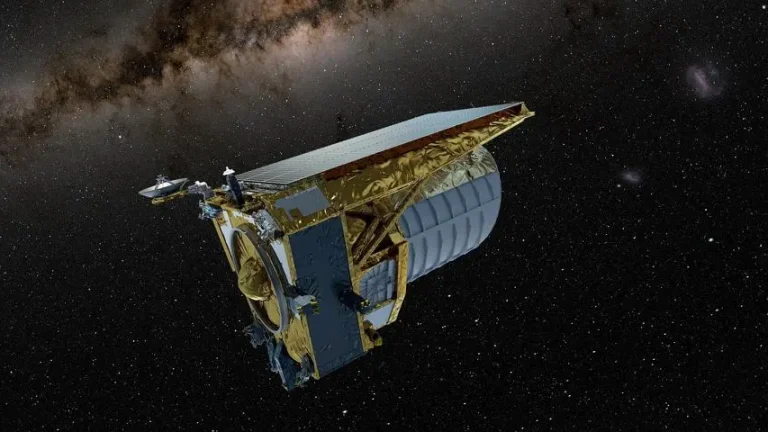
The mystery surrounding our dark and wild universe has baffled theorists and astronomers for nearly a hundred years. Even with the most advanced telescopes, the visible universe is only a fraction of what we can see.
Dark matter, which accounts for 20 percent of our cosmos, neither emits nor absorbs light. Instead, it gravitationally pulls in ordinary cases. Dark energy, responsible for our universe’s inexplicable expansion, makes up an incredible 76 percent. The known universe is made up of less than 4% ordinary matter. This includes stars, planets, and flesh.
We hope to learn more about this dark world.
The launch of NASA’s infrared detectors on the ESA’s Euclid Mission next month should provide new clues about the nature of dark energy and matter. The 1.2-meter mission is expected to provide only some answers but should give theorists plenty of data to work with.
Why does this telescope have such an exceptional quality?
ESA says Euclid will map the large-scale structure of cosmic time, covering the past 10 billion years. ESA says that the project will allow it to image 1.5 billion galaxies at a resolution similar to the Hubble Space Telescope while taking data on 50 million galaxies.
Jason Rhodes, a NASA JPL observational cosmologist, and the U.S. Euclid Science Lead, informed me via email that it has two science instruments. One uses visible light, while the other uses infrared. Rhodes says there is an optical component called a “dichroic,” which splits the incoming light into infrared and visible parts and then sends these components to the instrument of choice. Both devices have cameras that contain a large number of pixels. They can both observe the sky while collecting data, says Rhodes.
What is the biggest challenge Euclid faces?
Rhodes says that dark energy studies are statistical. He says that even a tiny systematic offset in the shapes or distances can affect our results. Rhodes says that this is why we wanted to use a space telescope above the Earth’s atmosphere for these measurements.
Rhodes says that Euclid can shrink the error bars in current measurements and possibly rule out many possible causes for the accelerating expansion. Rhodes says that eliminating these explanations can get closer to the physical cause of Dark Energy.
Euclid’s measurements are based on a two-pronged approach. The spacecraft will first measure the effects of dark matter on galaxies and then use these measurements to better describe dark energy.
In his office, Rene Laureijs told me recently that dark matter has distorted galaxy shapes. Laureijs says that you can deduce the accelerating growth from the distribution of dark matter.
Hans Winther of the University of Oslo, a member of the Euclid Science Consortium, told me recently in his office that our understanding of Galaxy Clustering is now so good that we can pinpoint the dark energy content of the universe. Winther says that we can measure our universe’s acceleration without relying on distance measurements from Type 1a supernovae.
What is dark energy?
Winther says that we are trying to figure out what dark energy is by studying the large-scale structure of our universe. He says that when looking at structure formation, you only care about gravity, object attraction, and expansion. Winther says that it’s a fight between these two.
In 1917, Einstein added his cosmological constant, a repulsive force, to his general relativity theory. This was before we understood the big bang and the universal expansion of the universe. To maintain the idea of a stationary universe and counter gravity’s effect on ordinary matter, Einstein added his so-called cosmological constant (a repulsive force) to his general relativity. Einstein quickly changed this aspect of his equations after observing the Hubble expansion, evidence of an expanding universe.
Theorists revived Einstein’s constant in the late 1990s as a repulsive force of quantum physics known as vacuum energy, background energy embedded within spacetime. In 1997 and 1998, the two Nobel Prize-winning teams discovered that our universe had begun expanding inexplicably five to seven billion years after its big bang.
Theorists of the present era have used the cosmological constant to explain dark energy. This solution seems temporary until we understand the nature of dark powers. The vacuum energy in the fabric spacetime may cause acceleration. Why did the dark energy’s acceleration force kick in only five to seven billion years after the big bang?
How do you calculate the value of a cosmological constant?
David Mota is a member of the Euclid consortium and a theoretical physicist at the University of Oslo. He told me recently in his office that this value helps us to understand how much dark energy, or cosmological constant, we should have today in our universe. Mota says there is a large discrepancy between the values we measure astronomically and those we calculate based on particle physics. He notes that when you figure, the energy in the vacuum can be up to 120-fold more significant than what we observe.
Which dark theory is the most puzzling?
Rhodes said, “My money’s on dark energy. We know less about it than dark matter, but it’s a bigger component of our universe.” In the distant past dark energy was a small part of the universe.
Rhodes says that dark energy will predominate in the future while dark matter will become a minor component. He notes that the nature of dark points will determine the fate and destiny of the universe.
Mota even goes further, claiming that the current theories we use to define the universe are probably wrong.
Mota says that we went on to Einstein and the curvature of space and time after Newton. In a million years, he hopes that humankind will be able to evolve and embrace new mathematical and physical theories. Mota says that, at this point, we’re just making baby steps.