For paleoanthropologists, the question of when our ancestors started spending more time walking over flat ground than hanging around in trees is a fascinating one – and it’s something that new research gives us a better understanding of.
A scientist has reconstructed muscles from the AL 288-1 fossil (better known as Lucy) using 3D modeling software. Models show Lucy had pelvic solid and leg muscles to cling to trees and knee muscles, which allowed her upright walking.
The fossil is from the Australopithecus Afarensis, a species of early hominin. Paleoanthropologist Ashleigh WISEMAN from the University of Cambridge, UK, is the researcher who carried out the research. She says the fossil tells us much more about the species’ life.
Australopithecus Afarensis would roam open wooded pastureland and more dense forests in East Africa between 3 and 4 million years ago,” states Wiseman.
These reconstructions of Lucy’s muscles suggest she could have exploited both habitats efficiently.
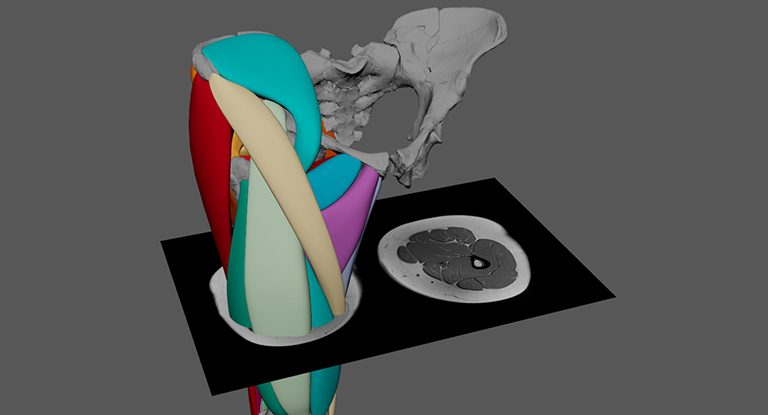
The 3D muscle model was completed (left) with the muscle attachment points used to build it. (Ashleigh Wiseman)
Lucy’s fossils were discovered in the 1970s. It was well known that A. A. afarensis can walk. However, there is still debate whether it was a waddle like a chimp or a gait similar to modern humans.
Wiseman used computer modeling to recreate the soft tissues that did not survive the fossil. Wiseman began by comparing the AL 288-1 specimen to what is known about living human bone and muscle structures. He then worked backward, looking for clues in the fossil’s dimensions, design, and traces left behind where muscles attach to bone.
Lucy could have stood upright with the powerful muscles generated by the models. The 36 forces reconstructed in each leg are more significant than the ones in modern people.
Wiseman says that the only way to determine Lucy’s ability to walk upright is by retracing the space and path that each muscle occupies in the body.
“We’re the only animals that can stand straight with straight legs.” Lucy’s muscles indicate she was just as adept at bipedalism and could have been at home in trees. Lucy probably walked and moved differently than any other living species.
A. Afarensis was shorter and had ape-like features. The muscle-to-fat ratio in their legs would have been much lower. Major powers in Lucy’s calves and thighs would’ve measured twice as large as those in humans.
This is the first time the soft tissue from an early human ancestor was reconstructed this way. It will not be the last. This same modeling technique can be applied to other fossils. While some guesswork remains, researchers have better computational methods than ever.
“Muscle reconstructions were used to measure the running speed of a T. Wiseman cites the example of a T. rex.
By applying similar techniques to ancient humans, we want to reveal the spectrum and range of physical movements that propelled human evolution and those abilities we have lost.