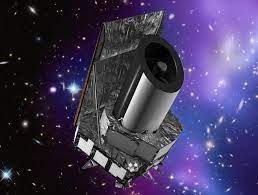
Scientists hope to uncover the secrets of our cosmos in a few short weeks as Euclid, the European space probe that has been highly anticipated, is about to embark on an innovative mission. It has a budget of EUR1 billion ($ 1.10 billion) and aims to explore the mysterious realms of dark energy and matter, components that we have never understood.
Scientists have yet to determine the true nature of dark energy and matter, forcing them to estimate their impact on galaxies. With the launch of Euclid on July 1, there are high hopes that we can finally gain deeper insight into these mysterious phenomena.
Scientists and astrophysicists from the United Kingdom are at the forefront of the cosmic quest. They have played an essential role in the design and construction of the Euclid probe. Professor Andy Taylor from Edinburgh University stressed the importance of Euclid. He said, “We can’t say that we understand the cosmos if these dark components remain a mystery.” Euclid’s reputation is due to this.
The mission was initially intended to launch using a Russian Soyuz, but the plans were changed due to geopolitical tensions. The European Space Agency quickly formed a new partnership with ESpaceX. This allowed Euclid to be launched into space using the Falcon 9 rocket.
Euclid will travel over a month to reach its final destination, 150 million kilometers away from Earth. Euclid, positioned at the second Lagrange Point, will reveal the celestial marvels by taking captivating images of deepspace, with Earth, the moon, and the sun as a mesmerizing background.
With a resolving ability similar to the Hubble Space Telescope’s, Euclid can simultaneously scan a third of the night sky and provide an incredibly detailed map of the heavens.
Gravitational lensing is a dark matter-produced phenomenon. This is one of the primary missions. Scientists hope to uncover vital clues regarding the composition of dark matter by analyzing complex lensing patterns. These data will be used to find dark matter particles on Earth. They can determine if they are made up of light particles or other larger entities.
According to Durham University professor Mathilde Jouzac, the gravitational lensing caused by dark matter will reveal much about its composition. This information will help to guide the search for dark particles on Earth.
The scientific community is anticipating a significant leap in understanding the universe’s fundamental structure with the launch of Euclid. Euclid is the key to unlocking the mysteries surrounding dark matter and energies as the cosmic veil slowly lifts. This will bring us closer to an understanding of the vast universe.