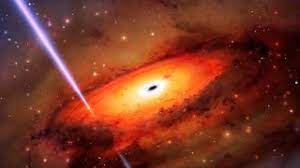
While searching for the source of a powerful GRB (gamma-ray blast), an international team of astrophysicists may have discovered a new method of destroying a star.
The researchers found that exploding stars or neutron star mergers did not cause GRB 191019A. Instead, it came from stars colliding in a dense environment around a supermassive dark hole at the center of an ancient galaxy. The atmosphere resembles a demolition derby, which points to an old-hypothesized but never-before-seen way to destroy a star.
The study will be published in Nature Astronomy tomorrow, June 22. Radboud University, a Dutch university, led the research team. It also included astronomers at Northwestern University.
The study’s coauthor Wen Fai Fong said that there is at least one oddball for every 100 events that fit the traditional classification scheme. “However,” he added, “it is these oddballs which tell us most about the spectacular variety of explosions the universe is capable of.”
The discovery of these exceptional phenomena in dense stellar systems is undoubtedly exciting, said Northwestern astrophysicist Giacomo Fragione. This remarkable discovery gives us a compelling look at the complex dynamics in these cosmic environments. It establishes them as factories for events that were previously thought to be impossible.
Fong is a Northwestern Weinberg College of Arts and Sciences assistant professor of physics and astronomy and a member of the Center for Interdisciplinary Exploration and Research in Astrophysics. Fragione is a CIERA research assistant professor. Other Northwestern coauthors are Anya Nugent and Jillian Rastiejad, both Ph.D. astronomy students and Fong’s research group members.
According to their mass, most stars die in one of three predictable manners. As low-mass, relatively young stars, like the sun, age, their outer layers are shed, eventually fading to white dwarfs. The more massive stars burn brighter, explode faster, and create ultra-dense objects such as neutron stars or black holes. Third scenario: two stellar remnants collide in a binary system.
A new study suggests that there may be a 4th option.
Our results show that stars may meet their demise within some of densest regions in the universe where they are driven to collide, said Andrew Levan, a Radboud University astronomer. This is exciting because it helps us understand how stars die and answers other questions, such as the unexpected sources that could create gravitational wave signals we can detect on Earth.
Ancient galaxies are no longer able to produce massive stars. However, their cores have many stars, white dwarfs, and other ultra-dense stellar remains, including black holes, neutrons, and white dwarfs. Astronomers suspected for a long time that, in the flurry of activity around a supermassive Black Hole, it was only a matter of when two stellar objects would collide to produce a GRB. Evidence for this type of merger still needs to be discovered.
Astronomers caught the first glimpse of this event on Oct. 19, 2019. NASA’s Neil Gehrels Swift Observatory detected an intense flash of gamma rays lasting more than one minute. GRBs lasting more than two seconds are considered “long.” These bursts are usually caused by stars that have at least ten times our sun’s mass collapsing.
Researchers then used the Gemini South Telescope in Chile, part of the International Gemini Observatory run by the National Science Foundation’s NOIRLab, to observe the GRB’s fading afterglow over a long period.
The astronomers were able to locate the GRB in a region that was less than 100 light years from the nucleus, an ancient galaxy, very close to the supermassive galaxy black hole. The researchers were also surprised to find no sign of a supernova that would have left its mark on the light captured in Gemini South.
Rastinejad performed calculations to ensure a supernova wasn’t hiding in the data. The location of GRB 193019A in the nucleus galaxy teases a theory that has not been proven yet but is predicted.
It is scarce for long GRBs to be produced in typical galactic environments by colliding stellar remains, such as black holes and neutron stars. In the cores of old galaxies, as many as a million stars could be packed into a small area just a few lights years across. This extreme population density may cause occasional collisions between stars, especially when a supermassive black hole is causing the stars to be thrown in all directions. These wayward stars eventually would merge and intersect, triggering an explosion that can be seen from vast distances.
Nugent, the modeler of the galaxy that hosted the GRB, said: “This event defies all expectations we had for short and long GRBs.” While long GRBs have never been found in galaxies that are as old and dead as GRB 193019A’s hosts, short GRBs, with their merger origins, have yet to be observed to be as connected to the nuclei of their hosts. The discovery of the event at the core of the galaxy’s old, quiescent host opens up promising new avenues for binary systems that were rarely observed.
This could be because such events are every day in similar crowded regions of the universe, but they have just been noticed. The galactic center could be awash with gas and dust, obscuring the GRB’s initial flash and afterglow. GRB 191019A is a possible exception that allows astronomers the opportunity to study and detect this burst.
Fong stated that while this is the first discovered event, there may be more hidden by dust near their galaxies. If the long-duration event were caused by merging compact objects, it would contribute to the increasing population of GRBs, which defies traditional classification.
The researchers hope to find more GRBs and match them with gravitational waves, revealing more about the true nature of the events. This will confirm their origins, even in murky environments. When it is operational in 2025, the Vera C. Rubin Observatory will be invaluable for this type of research.
The National Science Foundation, NASA, and the David and Lucile Packard Foundation supported the study “A long-duration Gamma-ray Burst of Dynamic Origin from the Nucleus of an Ancient Galaxy.” Other funders included VILLUM FONDEN and the U.K. Science Technology and Facilities Council.