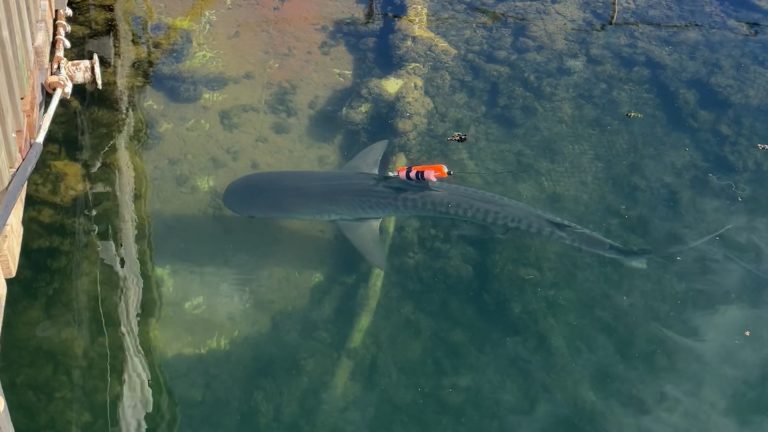
Scientists have documented the movements of a tiger shark, affectionately known as Boof, after it was released from captivity.
Researchers from the University of Western Australia (UWA), the UWA Oceans Institute, and the Australian National University collaborated with Ocean Park Aquarium to release Boof safely after spending two years in captivity.
The researchers could track the fine-scale movements of the sub-adult for 24 hours and compare them to those of a nearby wild shark that was tagged.
This study is essential because stress-related deaths in released sharks are not uncommon. Researchers tagged Boof and found that he exhibited more rapid turning movements and shallower swim than wild sharks – perhaps due to initial confusion – but they were confident he survived and was ready for life in the open sea.
The lead author, Dr. Oliver Jewell from UWA’s School of Biological Sciences, said that the safe release of captive marine life relied on studies of their movements after they were released, but more tracking was needed.
“Most studies that have investigated the movements of sharks after release from aquariums have used passive acoustic tags or archival telemetry to monitor things like dive patterns and migration. However, little has been considered about the changes to swimming and movement pattern,” Dr Oliver stated.
The ‘CamTag,’ used by Boof to record movement, is a high-resolution blogger that can capture much finer scales.
The CamTag was attached to Boof’s dorsal ray during feeding while he was swimming free. It was removed later that day.
Dr. Jewell stated that the research produced data sets that would help to develop best practices for ethical releases of captive sharks.
He said, “Such procedures will strengthen the public’s trust and support greater sustainability within the aquarium sector.”
Sharks are a popular attraction in aquaria. They belong to one of the most misunderstood, threatened, and endangered orders on earth, so housing them safely for long periods is a valuable educational tool.
The study, published in the Journal of Fish Biology, was part of a project called Gathaagudu Animal Tracking led by Associate Professor Ana M. M. Sequeira.