Webb Space Telescope captured an image of Saturn’s ringed moons, concluding its photo album on the gas giants of our Solar System.
Webb, a 10 billion dollar space observatory that will be launched in December of 2021, is the first major project to launch from Earth. The telescope consists of two images, the Near-Infrared Camera NIRCam, and the Mid-Infrared Instrument MIRI. Since July 2022, Webb has produced scientific photos.
Webb is primarily focused on the first light it can detect, dating back several hundred million years after the Big Bang. However, it is also providing insight into our stellar neighbors. This new image of Saturn is the last of the gas giants in our solar system or nearby worlds, mainly composed of hydrogen and helium.
Jupiter the first planet imaged by Webb in August 2022. In September, the Webb team took an image of Neptune and its moons. They followed up that shot with an idea of the rings surrounding Uranus.
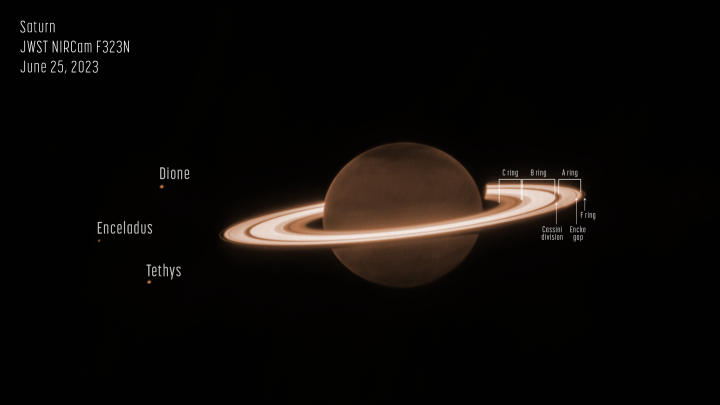
Webb’s NIRCam was used to capture the image. Saturn is dark due to the methane that absorbs most of the sunlight. Saturn’s rings, mostly made of ice or rock, remain bright.
The Cassini Division, a gap between Saturn’s A and B rings caused by the gravitational force from Saturn’s Moon Mimas, can also be seen in the image.
Saturn’s moons, Enceladus, Tethys, and Dione, are on the left of the picture. Webb scanned Enceladus’ surface in May and discovered a 9,656-km-long plume of water. Enceladus has a subsurface sea, which is vital to science because water is essential for life.
Data from the Cassini satellite, whose mission ended when it plunged into Saturn’s atmosphere in 2017, revealed phosphorus in Enceladus water. This is another indication of the possibility of life lurking beneath the moon’s icy crust.