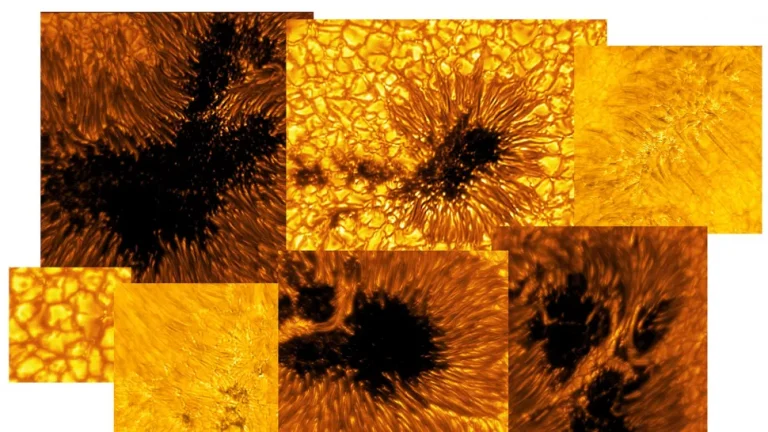
The largest solar telescope in the world has captured sunspots and other fine details on the sun with remarkable detail.
The Daniel K. Inouye Solar Telescope, located on Maui in Hawaii, has been collecting high-resolution information about the sun’s three layers of atmosphere for over a year. Scientists hope to use this data to answer the most critical questions about the sun. For example, why is the sun’s outer atmosphere hotter than the visible surface?
The DKIST mosaic, released recently, shows granular views of Earth-sized Sunspots in the lowest layer of the sun’s atmosphere, called the photosphere. Sunspots, which are dark, relatively cold patches, indicate the presence of strong magnetic fields and may indicate flares or coronal masses ejections.
These spots are characterized by dark, central regions called the umbra. This is where the most vital magnetic fields exist. The sunspots are surrounded by filamentary areas called penumbra. These are visible in the images as “bright-headed strings,” according to DKIST members in a description of an image published on Friday (19 May).
DKIST captured these images using a powerful camera known as the Visible Broadband Imager. This was the first instrument that came online when the telescope began operating, and it can take high-resolution pictures of the chromosphere and photosphere. Scientists say that the telescope has captured “fine dark threads” of chromosphere due to magnetic field activity below.
Sunspots are not permanent; they only last about a week. They grow and shrink in size as the sun moves through its 11-year activity cycle. A light bridge that spans a sunspot’s umbra in the latest DKIST images shows a sunspot “that will eventually break apart.”
DKIST team member wrote that numerous umbral fragments near another sunspot reveal “a lost penumbra sunspot.” It is scarce to be able to capture a penumbra in the process of decaying or forming.