In the universe’s early moments, protons, electrons, and neutrons were formed along with their antimatter counterparts. As the universe expanded, it cooled, and almost all of these antimatter and matter particles met and destroyed one another, leaving behind only flashes or photons.
If the universe was perfectly symmetrical with equal amounts of matter and antimatter, then we wouldn’t have been born. There must have been some imbalance, some protons, electrons, and neutrons left over, that led to the formation of atoms, molecules, and stars.
“If the universe was perfectly symmetrical, then all that would remain is light. This is an important moment in human history. “Suddenly, there’s stuff in the Universe, but why?” Eric Cornell, NIST/JILA fellow. “Why is there this asymmetry?”
Symmetry is required by the mathematical equations and theories that describe our universe. Particle theorists have refined these theories to address the issue of asymmetry. Cornell says that these theories are nothing more than math without any evidence. His group at JILA has therefore been looking for asymmetry in fundamental particles like electrons.
The JILA group made a record-breaking electron measurement, narrowing the search to discover where the asymmetry originated. The findings were published in Science.
JILA is operated jointly by the National Institute of Standards and Technology and the University of Colorado Boulder.
The electron’s electric dipole moment (EDM) is a good place to start looking for evidence of asymmetry. The EDM shows how evenly the negative charge of electrons is distributed between its north and south poles. A measurement of eEDM greater than zero confirms an asymmetry. The electron will be more egg-shaped rather than circular. No one is sure how slight this deviation could be.
Tanya Roussy is a graduate research student at JILA. She said, “We have to fix our math so that it’s closer to reality.” We’re searching for the places where this asymmetry may be so we can better understand its origin. The symmetry of electrons is a good indicator of the balance in the universe.
Cornell, Roussy, and their teams at NIST and JILA have recently achieved a new record in precision measurements of EDM. This is an improvement of 2.4 times over previous measurements.
How precise is this? Roussy said that if an electron were the size of Earth, any asymmetry would be smaller than an atom’s radius.
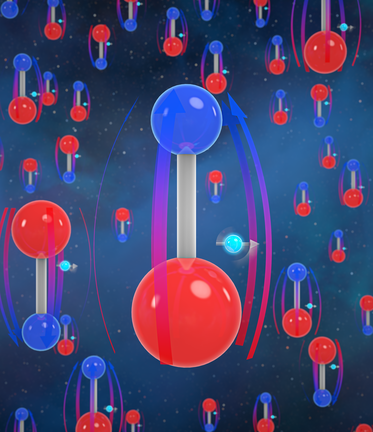
She says it is tough to measure this precision, so the group had to be very clever. Researchers studied molecules of hafnium-fluoride. When they applied an electric field strong enough to the molecules, the non-round electrons wanted to align themselves with the area and move around within the molecule. If the electrons were round, they wouldn’t move.
They used an ultraviolet laser to remove electrons from molecules, creating a collection of positively-charged ions and trapping them. By alternating the electromagnetic field surrounding the trap, they forced the molecules to align or not align themselves with the area. Researchers then used lasers to measure the energy levels in the two groups. If there were differences in the energy levels, it would mean that the electrons are asymmetrical.
Their experiment allowed for longer measurement times, improving their sensitivity. The group’s measurements revealed that electrons did not move energy levels. This indicates that electrons are round as far as we can measure them.
Cornell says that there’s no guarantee anyone will be able to find a measurement of eEDM other than zero. Still, the level of precision achieved by a simple tabletop experiment is impressive. This shows that expensive particle-accelerating machines are one of many ways to explore these fundamental questions about our universe. There are many other ways. While the group did not find any asymmetry, their results will help researchers continue to search for answers about the asymmetry in the early universe.
“We found that the electron was symmetric up to our measurements,” Roussy said that if we had found a nonzero value, it would have been a significant deal. “The best option is to have scientists from around the globe examine different options. We will all find the truth if we keep measuring it.