The study of brain biomarkers, powered by machine learning techniques that are cutting edge, could redefine how mental health conditions and disorders are classified and diagnosed. It may also lead to better-personalized treatments.
Yu Zhang is an assistant professor in the P.C. Department of Lehigh University, where he teaches bioengineering and electrical and computer engineering. Rossin College of Engineering and Applied Science, a National Institutes of Health(NIH) division, recently received significant funding from the National Institute of Mental Health. The two grants totaling nearly $4 million, will fund two projects that aim to find biomarkers using brain imaging, machine learning, and ML to improve the diagnosis and treatment of patients with mental disorders.
A biomarker can be defined as a type of sign that is used to indicate a particular medical condition and can also be measured.
The first study is aimed at improving the treatment of depression. According to the World Health Organization, 280,000,000 people suffer from depression around the globe. According to Zhang, the director of the Brain Imaging and Computation Laboratory at Lehigh, antidepressants are a primary treatment. However, they are only effective for about half of the patients who use them.
He says that “traditionally, medical professionals have used a combination behavioral and clinical symptoms in order to diagnose depression. These symptoms are subjective and can cause significant heterogeneity among patients.” Our goal is to create objective biomarkers that capture brain dysfunction better-using machine learning and brain imaging. These biomarkers allow us to predict how an individual patient’s brain circuits will respond to medication, which will guide personalized interventions.
Zhang and his team will use data from a double-masked, randomized, placebo-controlled clinical trial to establish biomarkers. This includes collaborators at Dell Medical School at the University of Texas at Austin (Dell Med), the Perelman School of Medicine at the University of Pennsylvania (PSOM), and Stanford University School of Medicine. Those data, including functional magnetic resonance imaging (fMRI) and electroencephalography (EEG) collected from patients before treatment, will be used to train a machine-learning model to identify biomarkers in the brain.
He says that the level of interaction between networks can indicate how a person will respond to medication.
After the team has built the model, it will be tested by an independent clinical study. Researchers at Dell Med will enroll approximately 50 patients diagnosed with depression. They’ll prescribe antidepressant medications and measure their symptoms.
Zhang says, “We’ll collect pretreatment brain imaging and use that data to optimize our biomarker discoveries.”
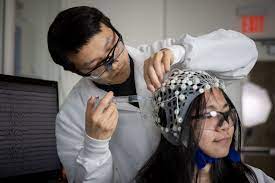
He imagines a future in which the model, which could be installed on any computer, would work with a portable EEG.
The EEG data of a clinic or hospital patient is fed into the model. The model would then use these brain signals to determine the strength or weakening of connections between brain regions, i.e., biomarkers, and generate output telling the doctor or clinician whether the person is likely to respond well to antidepressant medications based on the biomarkers.
Zhang and his team have focused on selective serotonin reuptake inhibitors (SSRIs). Still, the ultimate goal is to fine-tune the model to predict a person’s response to any compound accurately.
He says that their AI-guided Biomarker will not only provide a personalized treatment approach but will also replace the current treatment strategy of trial and error, which wastes time and money.
Zhang says that money is less important than time for many patients. Combining cutting-edge artificial intelligence with brain imaging can help people quickly and give them greater confidence in their treatment. This could be an example of precision mental health care that offers patients real hope.”
Zhang’s second newly-funded study will use brain imaging data again to identify biomarkers and redefine the classification for mental disorders.
Zhang says mental health conditions today are classified based on subjective behavioral and clinical assessment and self-reported questions. This can lead to many symptoms within a single diagnosis category, such as autism.
“Some patients show very different-; or heterogenous-; symptoms compared with other patients within that autism category,” he says. “At the same time, across categories like autism, attention-deficit/hyperactivity disorder, and depression, you’ll find considerable overlap, or comorbidity, in symptoms. We are convinced that there is a need for a deeper understanding of the heterogeneity of primary psychiatric conditions and their comorbidity. Our project will collect objective measurements from the body. We will combine brain imaging with machine learning to identify abnormalities of neurocircuits across traditional diagnoses. This will help us redefine mental disorders.
Zhang says redefining the classification system can help develop more effective patient treatments. Patients diagnosed with specific disorders are treated in a generalized way. Some patients may respond well to treatment, while others do not. Still, others might experience adverse effects. This is due to the vast differences in how people’s brains function. If the system was more tuned, treatment options such as psychotherapy and neuromodulation could be tailored to specific needs.
Zhang and his team will feed brain imaging data and behavioral assessment into a machine-learning model that will identify patterns of brain connectivity. These biomarkers can help explain mental conditions on a continuum.
He says that a diagnosis, at the moment, is a label. However, explaining these conditions on a spectrum can help us identify subpopulations in a clinical sample. Once we have identified these subtypes, we can study the unique and common brain abnormalities and determine the most appropriate treatment for each subtype.
Hopefully, doctors will eventually collect brain imaging and behavioral data on a patient. They will then feed this information into the model to determine which subtype the patient falls under and treat the patient according to the subtype.
Zhang says this work could redefine mental health conditions and significantly advance the field. It could help us develop more effective therapeutics, something that traditional clinical diagnosis cannot achieve.