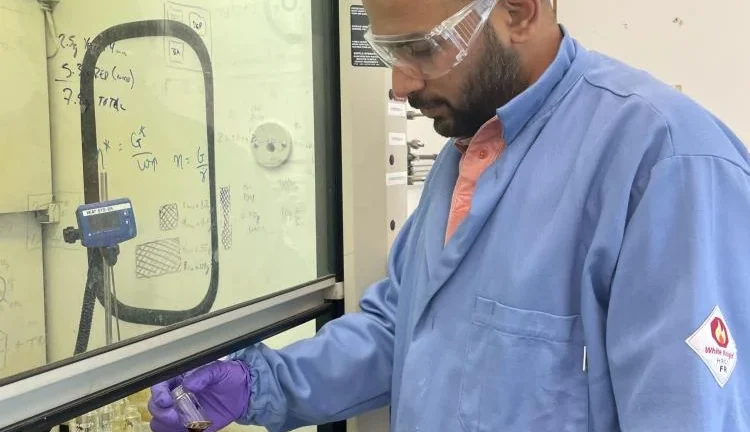
Karan Dikshit, PhDMatSci’22, is the first author of a paper published in ACS Applied Materials & Interfaces about new adhesive materials. These materials not only make it easy to stick and unstick, but they could also contribute to sustainability efforts across the globe.
Dikshit studied polymer chemistry and mechanical mechanics under Assistant Professor Carson Bruno at CU Boulder in the Material Science and Engineering Program. He spoke to us about his paper, current job, and more.
How did you arrive in Boulder, and what was your field of study at the College of Engineering and Applied Science?
Answer: Before joining CU Boulder, I had an incredible opportunity to gain experience in research at the esteemed National Chemical Laboratory of India. My passion for sustainable materials and scientific exploration grew during this period. When deciding on my next academic step, CU Boulder was a beacon for cutting-edge innovation and research – especially in the fascinating intersection between sustainability and soft material. The Flatirons, which provide a picturesque backdrop to the campus, also made me want to move here.
In the summer of 2022, I will have my Ph.D. in Materials Science and Engineering. FLO Materials is a Berkeley-based company that is dedicated to solving the problem of industrial plastic waste. FLO Materials wants to revolutionize this field with its groundbreaking platform technology, which allows for the creation of infinitely recyclable polymers.
How would you explain the results and work of this paper to an eighth-grade student?
Traditional adhesives, usually derived from petroleum refining, are hard to eliminate without harming the environment. As we explain in our paper, new eco-friendly adhesives such as cyclodextrin and polyrotaxane also adhere together but have other advantages, like being easy to remove without leaving residues or damaging the surfaces.
Bioderivable molecules are also used to make these materials. Cyclodextrin is made from starch, which comes from plants. It is possible to reduce the use of fossil fuels by using renewable resources.
What other applications could this research have?
These pressure-sensitive supramolecular adhesions have a wide range of applications in real life. These adhesives can revolutionize medicine by providing a gentle but secure bonding for bandages and dressings. The pressure-sensitive bonds also allow for painless and easy removal. This enhances patient comfort throughout the healing process. In electronics, these materials offer new opportunities to develop flexible circuits.
Q: What else would you like to add about your experience at CU Boulder
My time at the University of Colorado Boulder was a period of significant growth and personal development. Research, conferences, and seminars helped me take on new challenges outside my comfort zone. My communication skills were also improved by presenting my work to a larger scientific community.
The experiences I had not only helped me to deepen my knowledge but also improved my ability to think critically and solve problems. Beyond the academic world, I was able to work with individuals of diverse cultural backgrounds. These interactions broadened my perspective and helped me to appreciate different ideas and approaches. I was able to learn from my peers and build strong relationships by being part of an environment that is supportive and collaborative.
Aseem Visal, Femke Jenssen, Alexander Larsen, and Carson Bruns were also CU Boulder researchers involved in the research. This research was funded by the College of Engineering and Applied Science’s Rady Mechanical Engineering Department. ATLAS Institute and the National Science Foundation.