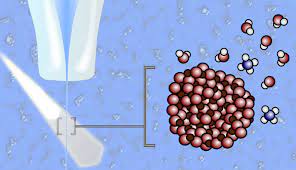
Green hydrogen can be directly produced by splitting water using solar energy in a photoelectrochemical device. This requires the development of super-efficient photoelectrodes, which must combine multiple talents: they must be able to convert sunlight into electricity and remain stable in acidic and elemental water. They also need to act as catalysts for splitting the water into oxygen and hydrogen. Metal oxides are a large class of materials that are being questioned. It is hard to determine what happens at the interface between the solid electrodes of metal oxides and the electrolyte aqueous. The reason is that standard X-ray analyses do not work when investigating processes on liquid samples. The experiments using a fluid jet, i.e., a fine spray of liquid containing nanoparticles suspended in metal oxide, are one of the few suitable methods. The plane is shot through the BESSY II X-ray, and the interference from the evaporated molecules on the measurement data is negligible.
Dr. Robert Seidel, an expert in this liquid jet technique, is featured in a special edition of Accounts Of Chemical Research. He was invited as guest editor of the issue and to report on new experiments, he conducted at BESSY II with Dr. Hebatallah Al and Dr. Bernd Winter from the Fritz Haber Institute.
The researchers investigated two critical photoelectrode model systems: nanoparticles (hematite or a-Fe 2O 3) and anatase particles (titanium dioxide, TiO 2), in aqueous electrolytes of different pH values. Photocatalytic models are hematite or anatase suspended in aqueous electrolytes. They are ideal for studying the solid/electrolyte interface at the molecular level and exploring the chemical reactions at electrode-electrolyte interfaces.
We used resonant-photoelectron spectroscopy to identify the fingerprints of various reactions. This allowed us to reconstruct which products are formed in different conditions, especially as a function of pH.” The critical question is how water molecules react on or with the nanoparticle surface.
Seidel pointed out that the acidity or basicity of an electrolyte can make a huge difference. At low pH, water molecules tend to break on the surface of the hematite. Seidel says that this is not true for anatase. Water molecules are adsorbed on the surface of TiO 2 nanoparticles. A basic pH level must break down water molecules to adhere to the anatase particles. Seidel says that this liquid-jet technique is the only way to gain such insights into water molecules’ interactions on surfaces.
The spectra revealed that the electron transitions between a metal oxide and (split water molecules) on the surface were ultra-fast. The results shed light on the early stages of water dissociation and help clarify the mechanisms that lead to water splitting when exposed to sunlight.
Special issue on ‘Applications of Liquid Microjets in Chemistry:
“Pour out a glass and place it one centimeter from your nose. What do you need to see? Between the tip of your nostril and the surface, about 3 million molecules are present. Imagine an X-ray photon, charged or neutral particles trying to escape or reach the surface but first colliding or interacting with these interloping molecules. This will scramble any information about their interaction with more profound and interfacial water molecules.
This problem, described so vividly in the preface of this particular issue, has been around for a long time. In 1988, the liquid jet technique, developed by Manfred Faubel and Stephan Schlemmer, allowed water surface studies to be conducted without disturbances. Microjets are fast-flowing streams of liquid that produce a very dilute vapor. Photons, particles, and vapor molecules can all reach the surface of the microjet and leave it without any collision. This method has now been used to produce exciting results in a special Accounts of Chemical Research issue. The guest editor was Dr. Robert Seidel, the HZB researcher.