A new alarming study suggests that the Gulf Stream may collapse as soon as 2025. This would be a disaster.
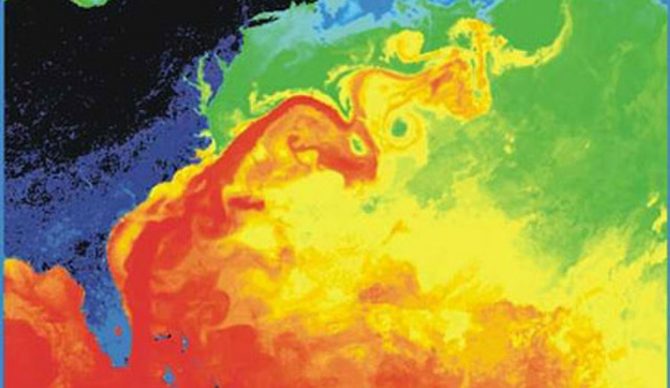
One of the most significant ocean currents is the Gulf Stream, the Atlantic Meridional Overturning Circulation (AMOC), to researchers. It is an essential driver of climate on the East Coast of America and Northwest Europe. This warm, fast-moving ocean current originates in the Gulf of Mexico. It then travels through the Straits of Florida and heads east to Europe, becoming known as the North Atlantic Current.
The Gulf Stream has already become significantly weaker. The Guardian stated that the Gulf Stream is weakest in 1,600 years due to global warming. Researchers have spotted warnings of a tipping point in 2021. To find out how bad the situation was, they conducted an analysis. They estimated that the world could collapse entirely between 2025 and 2020, with 2050 as a central estimate. If we do nothing about our out-of-control carbon emissions, that’s what will happen. During the ice ages, the Gulf Stream collapsed, and scientists believe that it caused a 10C temperature change over the next decade.
We can’t be sure that the predictions were 100 percent accurate. Still, it is inevitable that if Gulf Stream were to stop or dramatically change, global consequences would be catastrophic.
The BBC reported that a collapse of Amoc could have devastating consequences for millions of people in India, South America, and West Africa. It would cause storms to increase in Europe and temperatures to drop, leading to rising sea levels on the east coast of North America. The Amazon rainforest and Antarctica ice sheets would be further endangered.
This would not be the first Gulf Stream to shut down. There were several Amoc collapses between 115,000 and 12,000. Climate change was happening then, but modern man didn’t live through it.”I think we should all be worried,” said Peter Ditlevsen of the University of Copenhagen, Denmark, the study’s lead author. This would be a considerable change. “The Amoc hasn’t been closed for 12,000 Years.”
The study was published in the journal Nature Communications. Researchers used data on sea surface temperatures dating back to 1870 to determine the changes.
Researchers are divided on the possibility of a Gulf Stream collapse, but they all agree that the global consequences of such an event would be catastrophic.
Professor Niklas Bers, Potsdam Institute for Climate Impact Research, Germany, said this new study’s results are alarming. However, he added, if you include the uncertainties of the oversimplified model (of the tipping points) and the underlying data [sea temperatures], it is clear that the delays are too significant to estimate the time of tipping with any accuracy.