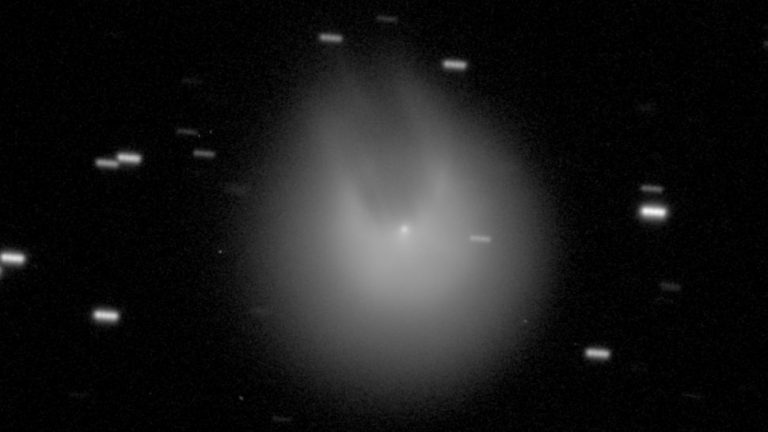
After exploding, an unusual volcanic comet flying toward the sun appeared to have “grown ears.” It now shines like a star and shoots supercold “magma” into space. This is the first comet to erupt in nearly 70 years.
This comet is called 12P/Pons Brooks (12P), a cryovolcanic comet. The comet, 12P/Pons-Brooks (12P), is a cryovolcanic or cold volcano comet. It is composed of a nucleus filled with dust, ice, and gas. A fuzzy cloud of gas surrounds the object, called a “coma,” which is seen leaking out from the interior. The gas and ice in 12P’s core build up so much that it can cause the comet to explode violently, releasing its frosty interior, called cryo-magma.
Spaceweather.com confirmed that on July 20, multiple astronomers observed a significant outburst of the comet. It suddenly appeared around 100 times more bright than usual. The increase in brightness was caused by the comet’s coma swelling up with the gas and ice released from its interior.
Richard Miles is an astronomer at the British Astronomical Association who studies cryovolcanic comets. He told Live Science via email that the comet’s nucleus has a diameter estimated to be around 18.6 miles (30 km).
The comet looks like it has sprouted some horns due to irregularity in the shape. Spaceweather.com reported that other experts have compared the deformed comet with the Millennium Falcon, another iconic Star Wars spaceship. Miles explained that the unusual form of the comet’s coma is probably due to a shape irregularity of 12P’s core. A lobe of the nucleus that sticks out may have partially blocked the gas from escaping, creating a “notch.” The notch or “shadow” became more visible as the gas moved away from the comet. The expanded coma, however, will disappear when the gas and ice are too widely dispersed to be able to reflect sunlight. Miles stated that this is the first significant eruption from 12P detected in 69 years due to its orbit taking it too far from Earth for outbursts from 12P to be observed.
12P has the most extended orbital period of any known comet. The floating volcano takes 71 years to orbit the sun. During this time, it is catapulted to the furthest reaches in the solar system. Spaceweather.com reports that the comet will reach its closest point with the sun on April 21, 2024. It is expected to make its closest approach to Earth on June 2, 2024. At this point, it will be visible at night. Earthlings may see more eruptions in the coming years.
Researchers are also monitoring another comet, 29P/Schwassmann-Wachmann (29P), which is the most volatile in our solar system. Over the past few years, there have been several notable eruptions from 29P/Schwassmann-Wachmann (29P) — the most explosive volcanic comet in the solar system.
In December 2022, astronomers saw the most significant eruption from 29P in around 12 years. This explosion sprayed approximately 1 million tons of cryomagma into space. In April of this year, scientists could accurately predict a 29P eruption before it happened. This was due to a slight brightness increase, which indicated that more gas would leak from the comet’s nucleus as it prepared for bursting.