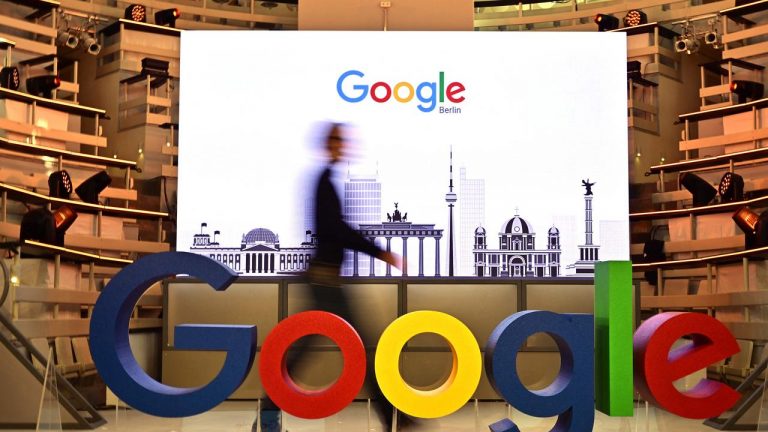
Alphabet, the parent company of Google, has seen its share price surge by A$82 Billion overnight following a single announcement.
Alphabet announced a significant update on its artificial intelligence platform (AI) to improve Google’s search algorithm Wednesday local time. (Wednesday evening/Thursday dawn AEDT).
Alphabet stocks went into overdrive after the news broke. Investors rushed to buy the shares and increased the company’s market value by billions, resulting in a five percent increase.
Google is introducing a new feature called ‘AI Snapshot,’ which displays AI-generated results over the regular Google search results.
The public’s response to Alphabet’s new Ideas Suite is very different from the announcement made in February at Google’s launch event of an AI tool named Bard.
The robot spewed out inaccurate information at the time in an advertisement for a company, causing shares to crash by nine percent, wiping $140 billion from the balance sheet.
At the Wednesday press event, the Alphabet also announced other updates, including PaLM 2, a large language model with over 100 languages for general use.
Google Maps now has a new AI feature, and the company also created a foldable phone.
Alphabet’s CEO Sundar Pichai stated that the company is making an “adventurous” move into a new field.
He said, “We are taking the next steps with generative artificial intelligence.”
With a bold, responsible approach, search is one of the core products we’re reimagining.
Google and Bing, the respective search engines of Alphabet, Microsoft, and Microsoft, have been fighting in the AI space and with search algorithms.
Alphabet responded by launching its own AI tool Bard, a response to Microsoft’s popular AI ChatGPT.
Bard’s short-lived success has temporarily reversed Alphabet’s fortunes.
Google shared an animated GIF earlier this year that showed how Bard would be used to respond to user queries.
The GIF included an example of a user asking Bard: “What discoveries can I share with my 9-year-old about the James Webb Space Telescope?”
The chatbot claimed that JWST “was used to take the first images of a planet beyond the Earth’s Solar System.”
Twitter users pointed out quickly that the answer was incorrect, as the first images of “exoplanets,” taken in 2004, were captured by the Very Large Telescope at the European Southern Observatory.