In its unprecedented detail, the James Webb Space Telescope (JWST) captured stunning images of the last stages of the life of a distant stellar.
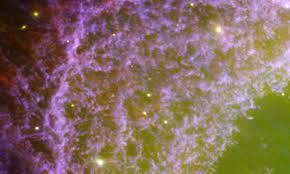
An international team released the images. They reveal a doughnut-shaped structure made of glowing gas called the Ring Nebula. This is a well-known sky object that lies 2,600 light-years from Earth.
A dying star sent a lot of material into space. This created rings of vibrant colors, expanding bubbles, and wispy, intricate clouds. The sun will suffer a similar fate when it dies in billions of years.
Images taken by the telescope’s Nircam near-infrared camera show the expanding shell of the nebula and the inner region surrounding its white dwarf star, which is a dense star about the size of a small planet.
These objects have nothing to do with planets and are called planetary nebulae. This term comes from the early days of astronomy when scientists with small telescopes believed they looked like planets.
The team led by Prof Michael Barlow, UCL’s emeritus professor in physics and astronomy, predicted that stars like the sun would end their lives by becoming white dwarfs. They will then eject their outer envelopes, which form beautiful planetary-like nebulae illuminated by their pre-white dwarf centers.
Chemical elements emitting light at different wavelengths are responsible for the colorful bands of the nebula. Astronomers hope that by analyzing these images, they can learn more about complex processes that generate nebula structure and life cycles of stars and the elements and substances they release into the universe.
“We don’t yet fully understand all the processes that take place during this caterpillar-to-butterfly-like phase,” Barlow said. The Ring Nebula, in Lyra, is the brightest and closest of all the planetary nebulae. It is an ideal target for JWST to study both the small and large-scale processes responsible for the dusty molecular structure we see in these images.