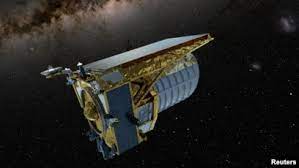
Last week, European astronomers unveiled the first images taken by the new Euclid Space Telescope.
Euclid was designed by the European Space Agency and NASA to study dark energy and dark matter. Scientists believe that dark matter and dark energy are 95 percent of our Universe.
ESA will lead the six-year project with NASA as its partner. ESA claimed that the images were among the most detailed ever taken. The photos show that the telescope can observe billions of galaxies as far away as 10 billion Light Years.
Images covered four different areas. The photos include 1,000 galaxies that belong to the Perseus galaxy cluster, which is 240 million light-years away. ESA stated that the image in the background shows more than 100,000 galaxy clusters.
Perseus Cluster is the name of the cluster that appears in the constellation or star group Perseus.
Scientists think that such large structures as the Perseus Cluster could have only formed if there was dark matter.
Carole Mundell, ESA’s director of science, said: “We believe we only understand 5 percent the universe – that’s what we can see.”
She continued: “We call the rest of the Universe dark because it doesn’t emit light…But, we can see its effects on visible matter.”
Scientists have found that galaxies are rotating faster than expected.
Mundell stated that it has the effect of pulling together some of the largest structures of the Universe, such as groups of galaxies.
Dark Energy is a New Mystery
Scientists in the 1990s established dark matter’s existence largely by studying supernovae or exploding star explosions. This work led to the Nobel Prize being shared by three U.S.-born scientists in 2011.
Scientists began to suspect that the Universe wasn’t just expanding but expanding at an accelerating rate after studying images taken by the Hubble Space Telescope. This surprising discovery was based on a brand new concept: dark energy.
A new galaxy map
Since its launch, Euclid has been undergoing testing. It will now start to take images in order to create a three-dimensional map covering approximately a third of the sky. Scientists will then use this map to search for tiny differences that are caused by the dark Universe. Scientists hope that the new understanding of dark matter and energy will help us understand how galaxies form and why they can be found throughout the Universe.
Mundell stated, “The Euclid mission’s purpose is to probe the dark sector in a way that we haven’t been able to do with our current ground and space-based missions.”
She said that the Perseus Cluster is a great example of this massive gathering of mass. “We believe there is a lot of dark matter pulling the galaxies in that cluster together.”
SpaceX Falcon 9 rockets launched Euclid in July from Florida.
The mission is expected to continue for six years. Euclid may continue to orbit the sun for another six months if fuel is available. Euclid orbits the sun at “Lagrange Point Two,” about 1.5 million km from Earth. It is the place where the gravitational pull of the Earth, the moon, and the sun are equal. It is possible to stay in this area and use less fuel. NASA’s James Webb Space Telescope, which is also at L2, is not in any danger of hitting Euclid.
ESA also released images of an unusual galaxy that ha
d no specific form. One idea was of a spiral Galaxy, also known as the “Hidden Galaxy.” It looks very similar to our own Galaxy, the Milky Way.
Mundell, when speaking of the Perseus Cluster, said: “You will also see many background galaxies, which is phenomenal. Last night, I saw a new universe.