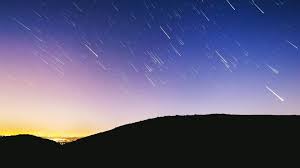
Perseid meteor shower will peak in the evening of Saturday, August 12, and last until the morning of Sunday, August 13. According to Western meteor investigator Denis Vida, conditions are ripe for a fantastic display. The new Moon will ensure the sky is dark for the best Saturday night viewing.
Western has developed a new website that tracks meteor activity (in partnership with NASA), which can help predict the show’s quality on any evening.
This means there will be very little interference with observations,” said Vida, project lead of the a There will be little interference to observations, said Vida. She is the project leader of Global Meteor Network and a postdoctoral fellow at Western Science.
Vida said you should look up if you are outside the city on Saturday or at the beach. A bright meteor streaks across the sky every few minutes. The meteors are originating from a star in the constellation Perseus. These meteors have nothing to do with Greek mythology.
Perseids are tiny dust particles that enter the atmosphere at a speed of 60 km/s. This is about 30 times faster than the F-35 fighter plane. They are so small, but they possess such energy that, when they collide with air molecules, the electrons released by the meteoroid and those from the atmosphere atoms can be excited or even ripped away from their host atom. This makes the atoms glow.
Vida said it only takes a short time after the meteoroid collides with air molecules for the atoms to emit light. This is when you see a glowing streak in the sky.
The best time to observe the eclipse will be right before sunrise on 12 or 13 August. Start your evening observation after 10 pm and look to the east or northeast. The Big Dipper is a good guide for spotting Perseids.
A camera in Belgium captured a time-lapse of all the meteors detected during the peak of Perseids. (Image by Paul Roggemans)
At the beginning of the evening, stargazers can expect to see about one meteor every two minutes. The meteor rate should increase steadily throughout the night, reaching more than one Perseid per minute just before dawn.
Vida recommends allowing your eyes 10 minutes to adjust to the darkness and avoid using mobile phones. You can also use a blue-light filter to preserve night vision.
Viewing Tips
- For a better view, get away from the city lights.
- When is the best time to go? What is the best time? Evening viewers can start looking after 10 pm, either east or northwest.
- You’ll be able to see the Perseids if you can spot the Big Dipper.
- Allow your eyes to adjust in the dark for 10 minutes. Use a blue-light filter or keep phones out of the way to improve night vision.
Collateral damage
Perseids are a spectacular spectacle, but they can also be dangerous.
A Perseid meteor destroyed Olympus-1 during an outburst in 1993. It was the largest civilian satellite for telecommunications ever built. It had been launched by the European Space Agency four years prior for $850 million.
Vida said that even though the dust particles responsible for meteors are sparse, given enough surface area and time, it is inevitable that a satellite will be hit. “And this time it did.”
The impact created a plasma cloud that shorted out the altitude control system of the spacecraft. The satellite’s operators managed to stop it from spinning out of control but had already depleted its fuel.
Vida is a member of Western University’s Meteor Physics Group, led by Peter Brown. Peter Brown holds the Canada Research Chair for planetary small body research at Western. Vida says the research team focuses on long-term meteor shower monitoring and developing predictive models.
Vida said that by monitoring and modeling, they can alert satellite operators to the possibility of a meteor shower and advise them to orient their spacecraft away from the direction the meteors will be traveling.
The Western-based Global Meteor Network, part of an initiative within Western’s Institute for Earth and Space Exploration, has proven crucial in monitoring meteor showers.
“GMN has over 1,000 cameras in 40 countries, including Malaysia and South Korea. We also have more than 1,000 cameras located in Mexico, South Africa, and Brazil. Vida, a woman present during a rare outburst of anger in May 2022, said there is no way we can miss a fit anymore.
We used the GMN data to inform NASA and satellite operators of this sudden outburst. The activity was relatively low, at 30 meteors an hour. Some people had predicted thousands, which would have made it much more dangerous to satellites,” Vida said.
Vida says that despite being one of the most studied and observed meteor showers, Perseids still can surprise. On August 14, 2021, an unexpected meteor shower with activity of up to 300 meteors per hour occurred.
“Only a few people were watching, but we caught it with hundreds of GMN cameras. Vida said that the outburst caught everyone off guard.
For the first time this year, data from GMN will allow us to estimate the actual intensity of the shower in real time. The information will be available online, allowing everyone to see how strong the Perseids shower is on any night.
Teachers and STEM coordinators are preparing to launch the program in September. The program will culminate with a virtual global conference, where students will present their work worldwide.
The Institute of Earth and Space Exploration has enabled the Global Meteor Network to achieve this level of international cooperation. This interdisciplinarity and support allowed the Global Meteor Network to become a global movement.
We have people from all backgrounds, professions, and walks of life. “Diversity is our strength, and everyone can contribute in their own unique way to the project,” said Vida. “We made the software open source, and allowed individuals to customize their cameras however they wanted,” said Vida.
Vida is now looking to expand the use of meteor camera data to monitor light pollution and the effects of satellite mega-constellations.