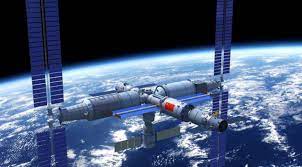
A space station is a human-crewed spacecraft in orbit for many years. It represents the scientific and technological power of a nation. The China-manned space program was approved in 1992 with a three-step strategic plan. Building a space station is the ultimate goal of this plan. China’s operated station project was established in September 2010. On April 29, 2021, after 11 years of relentless efforts at the Wenchang Spacecraft Launch Site (Hainan), the Tianhe module was successfully orbited by the Long March-5B carrier rocket. China completed its space station assembly as planned with 11 launches, including on-orbit missions. China, after the Soviet Union and the United States, will be the third country to be able to build and operate independent space stations with the completion and operationalization of the Tiangong station. China’s space station will contribute to the peaceful use of the universe by enabling humanity. In a recent research paper published in Space: Science & Technology by specialists at the Institute of Spacecraft System Engineering of China Academy of Space Technology, they introduce the design of Tiangong’s space station. They summarize its technical characteristics and discuss future applications and development of Tiangong.
The authors first introduce the design scheme of Tiangong’s space station. The Tiangong space station is arranged in a T shape, with two experiment modules, Wentian and Mengtian, respectively, on each side. 1). The Tianhe module comprises three parts: the node cabins, the life control cabins, and the resource cabins. The module has a 16.6-m total axial distance and a maximum radius of 4.2m, as shown in Figure. 2. The Wentian module comprises three parts: the working cabin, the airlock cabin, and the resource cabin. The axial length is 17.9 m with a maximum radius of 4.2 m. 3. A small robotic arm, an experiment platform, and a truss are also positioned outside the module. The Mengtian module comprises four parts: the working cabin, cargo airlock cabins, load cabins, and resource cabins. The axial length is 17.9 m with a maximum radius of 4.2 m. 4. Outside the load compartment, two deployable platforms are provided for payloads that will be exposed in orbit. The Tiangong station also has three docking hatches, one for forward docking (primarily for docking manned spaceships and the Xuntian telescope), another for backward docking (primarily for docking cargo spaceships), and a third for radial docking (primarily for docking manned spaceships). The control and propulsion systems include control moment gyros (for controlling the spacecraft), a reaction-control system (for controlling the cargo spaceship), a propellant refueling, and Hall electric propulsion systems. The energy system has a large number of flexible solar panels. The manned-environment system is equipped with complete life-support systems, both regenerative (regenerative) and nonregenerative (nonregenerative). The robot arms comprise the sizeable 7-degrees-of-freedom robotic arm and the smaller 7-degrees-of-freedom arm. Both robotic arms have sensors for visual measurement, joint torque, and end-effector forces. The airlock and node cabins of the Wentian experimental module and Tianhe core modules support the extravehicular activity. The residence of the crew is equipped with a minimum activity area of 110 m 3.
Authors summarize the technical features of advanced nature. The four main aspects are the most important in describing the Tiangong station’s technical characteristics. (1) The advanced concept of design. China will adopt a unified technical system and design framework for the Tiangong station. This will allow the GNC, energy, thermal control, information, and manned environments of the three modules to be connected and work together. The space station can integrate intermodal resources effectively, improving system reliability and capacity. The high proportions of new technologies. The space robotic arms, the physicochemically regenerable life support, and the large-area, flexible solar arrays are all unique technologies that have been applied to orbit in China for the first time. They also pose a high level of application difficulty and risk. The Tiangong station is also a brilliant space station on the equipment and system level. (3) excellent cost-effectiveness. According to China’s conditions and practical requirements regarding construction costs and application benefits, the Tiangong station was designed moderately, compared to the ISS or Mir. It will also be more efficient and economical in its construction and operation. (4) A safe and efficient home. The Tiangong station was designed with the human-oriented principle in mind. The design is aimed at ensuring the safety and comfort of the crew and supporting the crew’s intelligence.