Jupiter is the most stormy place in the Solar System. But Saturn is no slouch, either. New research has revealed that Saturn’s ringed giant is also home to persistent mega-storms, which can last for a century. They can also leave behind deep atmospheric scars.
A team of astronomers, led by Cheng Li of Michigan University, has analyzed the radio waves that Saturn emits. They have found long-lasting signs of storms, including equatorial ones from hundreds of years back.
This fascinating insight into Saturn’s dynamics can help us determine the cause of strange Megastorms which rage every few years.
“Understanding mechanisms of the biggest storms in our Solar System places the theory of hurricanes in a wider cosmic context, challenging current knowledge and pushing boundaries of terrestrial weatherology,” states Li.
Saturn’s ring system is impressive but looks beige and bland when viewed in optical wavelengths.
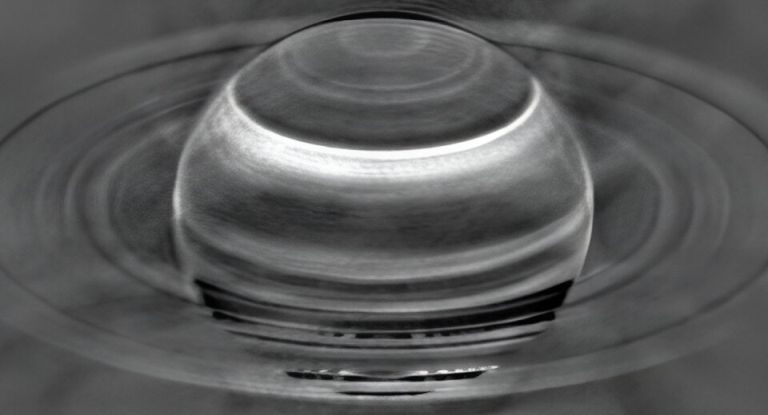
Radio light allows astronomers to see contrasting air bands surrounding the planet. Ammonia is a radio-blocking substance, so this unique perspective will enable astronomers to map ammonia levels in Saturn’s atmospheric layers.
Li and his co-workers used the National Radio Astronomy Observatory’s large array to make detailed radio observations of Saturn. They then used these data to examine the distribution of ammonia within the atmosphere.
Saturn’s atmosphere consists primarily of hydrogen and Helium, with only traces of methane and ammonia. However, ammonia dominates its upper cloud layer. Scientists can probe beneath the upper cloud layer using radio observations.
Radio wavelengths allow us to probe beneath the cloud layers visible on giant planets. Because chemical reactions and dynamic changes will affect the composition of a world’s atmosphere, it is necessary to observe below the cloud layers for the accurate atmospheric composition of the planet, which is a crucial parameter when creating planet formation models, says Imke de Pater of the University of California Berkeley.
Radio observations characterize dynamic processes in the atmospheres and giant planets, such as heat transport, cloud growth, and convection.
The brighter bands in the radio images show a lower concentration of ammonia. The team, as expected, found ammonia at Saturn’s top layer of clouds. However, they also discovered anomalous concentrations of ammonia between 100 and 200 kilometers deep in Saturn’s atmosphere. The region in between is
mainly free of ammonia. The team’s analyses suggest that the mega storms on Saturn, which occur every 28-30 years (so, once a Saturn Year), precipitate ammonia further into the atmosphere, where it evaporates and is transported back to cloud tops. Ammonia concentrations can last for many years after the storm has passed.
Researchers could trace anomalies identified in all six mega storms recorded since 1876 on Saturn. The researchers also discovered a monster they believe is a remnant of an older mega-storm.
We compare events on Jupiter and Saturn because they are both gas giants. These findings show that Saturn and Jupiter are more different than previously thought. The bands of dark and lighter clouds on Jupiter are linked to temperature anomalies. Saturn’s storms are the main attraction. This clue can help us understand how gas giant exoplanets may evolve.
The next mega storm will likely occur in 10 to 20 years. We will be fascinated to learn what it has to teach us.