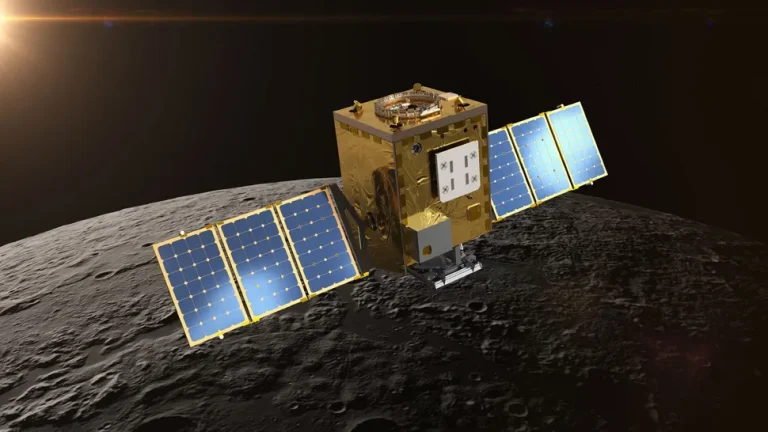
NASA’s Lunar Trailblazer is ready to launch.
It is a small satellite weighing about 440 pounds (240 kilograms) and measuring 11.5 feet (3.5 meters). The Lockheed Martin Lunar Trailblazer was built by the company. It will launch by 2024 on a rideshare mission with the IM-2 mission.
LTM is designed to use infrared light to map the surface temperature of the Moon and variations in the minerals that make up the lunar surface; according to a Jet Propulsion Laboratory (JPL), LTM uses infrared to ma ” “he tem” erature of the Moon and tEarths’ariations in minerals that make up lunar s” face. This is according to a Jet Propulsion Laboratory statement. The satellite can determine where on the moon water may be located. The innovative teams in Oxford and the U.K. have done a great job designing, building, testing, and now delivering LTM to its moon trip, especially considering the challenges of the recent pandemic,” University of Oxford scientist Neil Bowles stated. The data collected from this mission will allow us to”better understand the way water moves across the surface of the Moon and how it could be captured in cold traps at the poles. This information can then be used by future robotic human exploration.
In 2021, NASA’s Jet Propulsion Laboratory installed the other instrument on Lunar Trailblazer – the High-Resolution Volatiles and Minerals Moon Mapper HVM3- in Southern California. It measures the wavelengths of light reflected from froNASA’smoon to detect the chemical fingerprint for possible water on its surface.
The U.K. Space Agency’s Head of Space Exploration, Libby Jackson, said, “The Lunar Trailblazer Mission will give us fascinating insights into inAgency’sature and characteristics of water on our natural” satellite, improving our understanding of it, as well as how we can harness its resources to explore the planet further.”
Lunar Trailblazer is the latest in many probes, landers, and rovers heading to the Moon to look for wa”er ice. This ice could be helpful to future crewed missions. NASA launched the LunaH Map cubesat in November 2022, along with the Artemis 1 mission designed to detect the water ice on the lunar surface.
NASA’s ShadowCam on the Korea Pathfinder Lunar Orbiter has been mapping possible landing sites close to the south pole of tNASA’sn, where the crewed Artemis 2 mission will land in 2025 if everything goes to plan. The lunar south pole has a lot of water ice, which could be helpful to future astronauts.
It’s not only the United States looking for water on the Moon. Russia’s Luna-25 mission and India’s Chandrayaan-3 It’s both land on the Moon this month to search for lunar wateRussia’s