The Solar System contains a lot of water. Water is found on several moons, planets, and comets. It sublimates in the heat from the Sun and drifts away into space.
Water vapor was added to the Main Belt recently. The James Webb Space Telescope shows that water exists in the asteroid Belt.
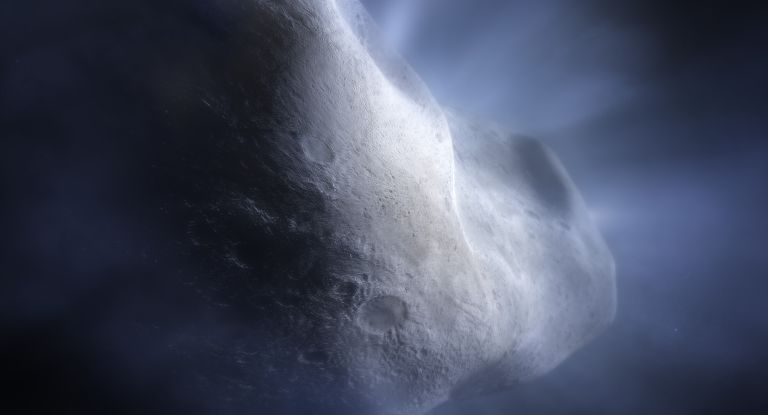
Comet 238P/Read has preserved water from forming the Solar System. Scientists thought conditions were too close to Sun for much water to remain.
This discovery confirms that comets in the Main Belt have enough ice to produce the vapor released when the ice sublimates. Before this, Main Belt comets were only detected as dust, not smoke.
Henry Hsieh, a planetary scientist at the Planetary Science Institute, US, says: “We have gathered a large body of evidence since the discovery of main-belt comets that their activity can be produced by sublimation. But until now, all of it was indirect.”
This new result represents the first direct proof of sublimation in the form of water outgassing or any other kind of outgassing from a main-belt comet. It follows studies from 2008 to detect outgassing from main-belt comets using some of the largest ground-based telescopes.
Asteroids are the majority of objects that make up the asteroid belt. They are relatively inert rocks that float around in space. Comets are defined, however, by their activity. Their icy and dusty composition primarily influences this.
The orbits of these comets are large and elliptical, and they usually originate from the outer Solar System. As they approach the Sun, the ice sublimates. This creates a gaseous atmosphere.
We have yet to detect many comets in the Main Belt. However, because they are so close to our Sun, relative to other comets, scientists were still determining if there was enough frozen material for the sublimation seen with comets from further distances.
Even though Comet Read is entirely within the asteroid Belt, it’s still a pretty large area of the Solar System that the object can move in, and there’s still an object with a perihelion. JWST was used by an astronomer from the University of Maryland, Michael Kelley, to study its orbit for any signs of outgassing closely.
Researchers captured and analyzed, using the telescope’s near-infrared spectrograph, the spectrum light that came from the fuzzy haze around the comet at perihelion. The peaks of the spectrum showed that not only was there outgassing, but also water.
Kelley explains, “In the past, we have seen objects in the main belt with all the characteristics associated with comets. But only with the precise spectral information from JWST can we say that water ice creates that effect.”
With JWST’s observation of Comet Read, it is now possible to demonstrate that water ice from the early Solar System may be preserved within the asteroid belt.
Something was oddly missing. Researchers could not detect any carbon dioxide coming off Comet Read, which is a striking and puzzling contrast with other comets of the Solar System. Carbon dioxide usually makes up 10-20% of the volatile substances in these comets.
Because water ice and carbon dioxide ice melt more quickly, this compositional anomaly can be explained in two ways. The comet may have had some carbon dioxide but has lost all of it. However, the water ice remains. One explanation is that the area in the Solar System where Comet Read was formed was too hot for carbon dioxide.
It may take more work to investigate the probability of these scenarios. The answers provided by Comet Read also gave astronomers much to think about.
Hsieh explains that “Water in Main-Belt Comets is Important because Objects from the main asteroid Belt have been proposed to be a possible source of Earth’s Water in the Early Solar System. The modern-day Man-Belt Comets seem to provide an opportunity for testing this hypothesis.”
This only works if the comets do contain water ice. “The confirmation of water outgassing from at least one main belt comet confirms the possibility of learning about Earth’s origins of water by main-belt comets.”