Astronomers have observed the outer region of a supermassive blackhole’s accretion disc, improving our understanding of this feeding cosmic monster.
Astronomers observed the outer edge of the disk of matter that surrounds a supermassive, feeding black hole for the first time.
These observations can help scientists understand the structure that surrounds these cosmic monsters and how Black Holes feeds on them. They can also determine how this feeding affects the evolution of Galaxies, which house such phenomena.
Feeding supermassive Black Holes are located at the heart of regions of intense brightness known as active galactic nuclei. The accretion disks can reach 18 million degrees Fahrenheit (ten million degrees Celsius) due to the incredible gravitational force of supermassive objects. The structure emits radiation across the spectrum. This includes high-energy Gamma-rays, X-rays, visible light, radio waves, and infrared. AGNs are so bright they can outshine all the stars in the galaxies around them.
Even with such a powerful output, accretion discs are still difficult to image directly because they are so small and often located in extremely distant galaxies. Astronomers can also use the entire light spectrum to determine an accretion disc’s size and understand its physics.
The team, led by Brazilian researchers at the Instituto Nacional de Pesquisas Espaciais (INAPES), used this technique. Denimara Dos Santos, Alberto Rodriguez-Ardila, and others studied the accretion disc of the distant quasar III Zw 002 in the center of galaxy Messier 106. M 106 is located in the constellation Cane’s Venatic, some 24 million light years away from Earth.
For the first time, the team observed near-infrared emissions lines in the spectrum light from the accretion disc of this quasar. These lines allowed the researchers to measure the plate-like structure that feeds the supermassive black hole. The mass of this supermassive is estimated to be between 400 and 500 times the sun’s mass.
In a press release, Rodriguez-Ardila stated, “this discovery gives us valuable insight into the structure and behavior of the broad-line region in this galaxy. It sheds light on the fascinating phenomenon happening around supermassive Black Holes in active galaxies.”
Excitement around accretion disks
The team studied emission lines that occur when an electron absorbs energy and enters what physicists call an “excited” state. These atoms must eventually return to the lowest point or “ground state.” This drop to the ground state releases light at wavelengths and energies characteristic of a bit from a particular element.
These emissions can identify the elements in a star or planet’s atmosphere and, in this case, the accretion disc around a black hole.
The emission lines of stars and other sources appear as thin spikes on spectra. However, the violent conditions surrounding a supermassive Black Hole cause the accretion disc emission lines to appear completely different.
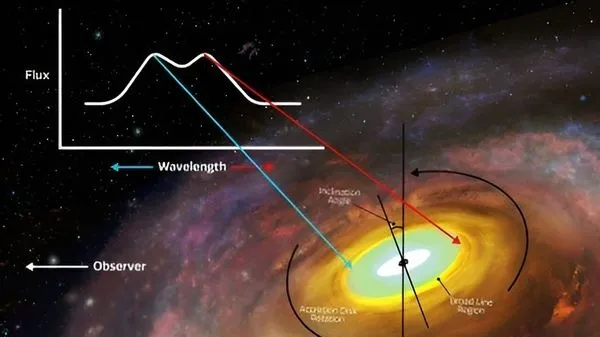
The emission lines associated with the supermassive hole are widened, and their peaks become shallower as matter near it accelerates to speeds close to those of light. This region is called the broad line area of the accretion disc.
The other side of the accretion disc moves away as one side moves towards Earth. The accretion disc rotates towards us, resulting in shorter wavelengths of visible light.
It’s similar to the sound you hear when an ambulance races toward you in a city. Sound waves from the siren are grouped, creating a short-wavelength sound with high frequency. The soundwaves spread out as the ambulance moved further away.
The Doppler effect is a phenomenon that causes light from an accretion disc to have two peaks. One peak corresponds to the side of the disk moving away from Earth, while the other corresponds to the side rapidly moving toward Earth.
These double-peaked and broadened emission lines observed from the inner region do not give astronomers a clue about the size of accretion discs. If those lines were visible from the outer edge of an accretion disk, they would.
The team of astronomers detected two double-peaked near-infrared profiles in the broad-line region of III Zw002. One line originated from the inner part of the disk of the broad-line area, and the other line was generated by oxygen at the outer edge of this region.
The emission lines could be found in data collected by Gemini Near-Infrared Spectrographs (GNIRS), a device capable of simultaneously observing an entire near-infrared spectral range. The team captured a clean, calibrated spectrum of the quasar.
Rodriguez-Ardila stated they didn’t realize III Zw002 had a double peak profile until we reduced the data. “We reduced the data several times, thinking it might be an error, but we always saw the same result.”
The team determined that the hydrogen line originated at a distance of 16.77 light days from the supermassive central black hole. Meanwhile, the oxygen line came from a radius of 18.86 light days.
They were also able to determine the outer radius of the broad-line region. This was estimated to be 52.43 light days. The team also calculated that the broad-line part of the disk’s accretion is tilted by 18 degrees relative to Earth.
The team will continue monitoring the quasar II Zw 002, observing its changing profile over time and using near-infrared for other AGNs.