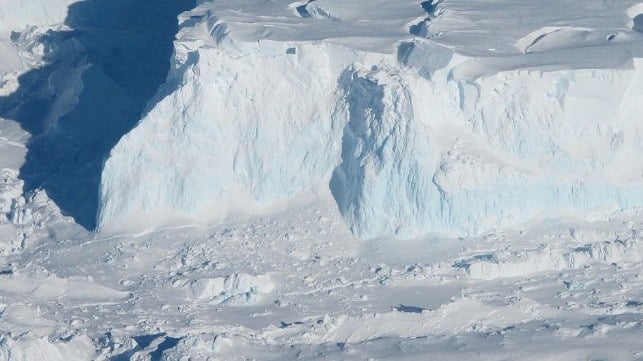
New research has shown that melting Antarctica ice slows one of the world’s most essential deep ocean currents, which could impact marine ecosystems. Antarctica has a unique environment that affects the climate and oceans of the world.
About 250 trillion tonnes of dense, oxygen-rich, and salty water sinks yearly near Antarctica. Antarctic Bottom Water is the name of this water. It is responsible for deep ocean circulation and supplies oxygen and nutrients to the deep Indian and Pacific Oceans.
A new study by the Commonwealth Scientific and Industrial Research Organization, an agency of Australia’s government, indicates that the AABW has slowed down with the reduced sinking density of water in Antarctica.
Our observations indicate that deep ocean circulation has been slowed by 30 percent since the 1990s. The study’s principal researcher, Dr. Kathy Gunn, said that this slowdown would have impacts for decades to come.
According to reports, the slowdown in deep ocean currents is due to increased melting of Antarctica’s glaciers. This makes surface waters less salinized and more buoyant. The result is that less dense water will sink from the surface into the depths. This interruption of the critical process, which replenishes deep ocean oxygen, could have a far-reaching effect beyond the immediate sea.
Professor Matthew England, the Deputy Director of Australia’s Center for Excellence in Antarctic Science (ACEAS), said that, according to a recent climate modeling exercise in which he took part under a high-emission scenario from the IPCC (Intergovernmental Panel on Climate Change), the flow of AABW will slow down by over 40% by 2050.
Prof. England said that trapping nutrients in the deep sea would reduce the amount of nutrients available for marine life at the surface.
Kathy and her team developed a new way to measure the deep circulation in the Southern Ocean, which is a relatively recent phenomenon compared with other seas. This new study was made possible by this method. It was the first time a volume transport estimate of AABW could be based on observations.
The study concentrated on the Australian Antarctic Basin because of its history, which has shown significant changes in AABW. It is also most likely to be an emerging early warning signal.
We are used to thinking that melting the Antarctic Ice Sheet causes sea level rise. This work shows that melting glaciers can profoundly impact ocean chemistry and climate.