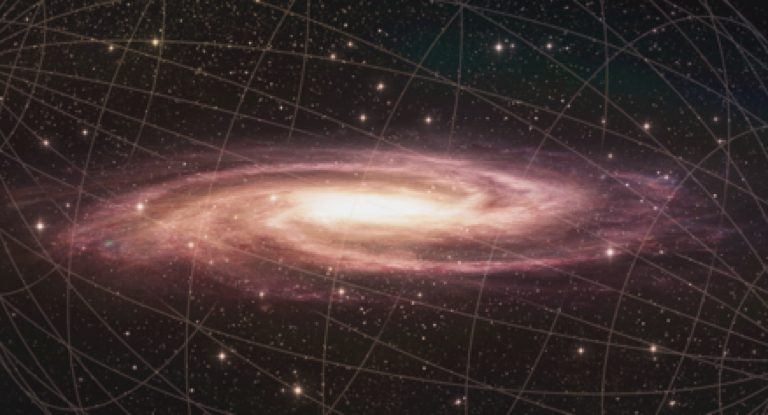
The Milky Way disk could be warped and twisted because of a huge, invisible mass.
New research shows that the tilted and misaligned Dark Halo, the large blob of Dark Matter that wraps around our galaxy and permeates it, is the only explanation that can explain all of its features.
There’s no need to worry, but this could provide us with some new information on the evolution of our Milky Way through the ages, which we are piecing together clue-by-clue.
The team, led by Jiwon Jesse Han from the Harvard & Smithsonian Center for Astrophysics CfA, writes: “Here we demonstrate that a dark halo angled in the same directions as the stellar halo could induce a warp in the Galactic disc at the same amplitude as the orientation of the data.”
These results, combined with the data from the stellar halo, provide compelling evidence that we are embedded in a tilted halo of dark matter. This misalignment between the dark halo, the disk, and the galaxy’s formation history is the next step to dynamically modeling the Galactic Potential.
You can’t see the shape of the galaxy in which you live. We can’t just send a camera into intergalactic orbit to take photos. While astronomers had known for a while that the disk was warped, we did not have enough data to determine what was happening.
The Milky Way’s wonkiness was only revealed in full detail by astronomers after Gaia. This space telescope maps the positions and speeds of stars in the Milky Way.
Astronomers have discovered powerful evidence that a flare or warp has occurred around the outer edges of the galaxy. It needs to be clarified what caused it. There could be a past interaction or a current with another universe.
According to Han, neither the astronomer Charlie Conroy nor the astrophysicist Lars Henquist of CfA, who are both members of CfA, have been able to explain both the warps and flares.
A team led by Han Conroy and Han made an intriguing discovery last year. Also has a misalignment for the halo around the galaxy, the diffuse globe of stars and gas in which the galactic disc revolves.
This led researchers to conclude that the Milky Way’s dark halo was also tilted. This is a dark matter globe that wraps around the majority of galaxies. It’s an otherwise undetectable matter that interacts gravitationally with normal weight.
They then conducted simulations and models to see if it was possible to reproduce the observed Milky Way shape, including warp and flare.
The researchers created a galaxy model in which the dark halo is tilted by 25 degrees relative to the disk of the Milky Way. They then calculated the orbits and movements of stars and gases over a five billion-year period. The researchers found that when the dark matter blob is tilted, the outer edges of the galaxy warp and flare. This is exactly what we observe in the Gaia observations.
This is not to say that a galactic encounter does not exist. The team believes it is likely. Their results suggest the interaction is past and not ongoing. The simulation revealed that a collision can cause the dark halo to be tipped significantly. It also showed that the warping of the galactic disc occurs quickly, within an orbit after the dark-halo tilt.
After the event, the tilt of the dark halo slowly returns to normal. In the simulation, it took 5 billion years for the dark halos to decrease from 50 degrees to just 20 degrees after a galactic collision 7 billion years earlier.
The researchers write that “this result shows that the Milky Way’s dark halo has likely been more tilted at one time and decreased to its present value (25°) today.”