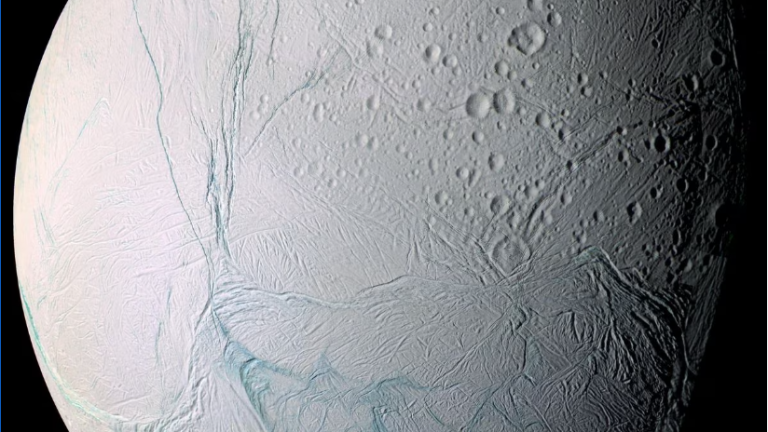
Researchers reported that they detected high phosphorus concentrations in the ice crystals spewed out of Enceladus’ interior ocean, increasing its ability to harbor life.
This discovery is based on the data collected by NASA’s Cassini, the first spacecraft to orbit Saturn. Cassini spent 13 years exploring the giant gaseous planet, its rings, and its moons between 2004 and 2017.
NASA’s Jet Propulsion Laboratory, located outside Los Angeles and led by German scientists, published the findings in Nature. The JPL designed and built Cassini.
The same team confirmed previously that Enceladus ice grains contained a rich array of minerals and organic compounds, including ingredients for amino acids associated with life, as scientists understand it.
The equation was missing phosphorus, one of the six essential chemical elements for all life forms – carbon, oxygen, and hydrogen are the other five.
In a JPL release, Frank Postberg (a planetary scientist from the Free University of Berlin) said, “This is the first time that this element has been found in an ocean outside Earth.”
Phosphorus is essential to the DNA structure and is a part of all cell membranes, energy-carrying molecules, and life forms on Earth.
This latest study is based on Cassini’s measurements. It flew over salt-rich ice particles ejected from geysers that erupted from the subsurface sea beneath Enceladus’ frozen crust at its southern pole.
The spacecraft collected its data by passing through a plume containing ice crystals and the same material that feeds Saturn’s “E” ring, a faint ring outside the planet’s main rings.
Enceladus, about one-seventh of the size and sixth largest natural satellite of Saturn, has been identified as a candidate for searching for other places in our solar systems that may be habitable – even if it’s only microbes.
Europa, Jupiter’s bigger Moon, is another that is thought to have a liquid ocean beneath its icy surface.
The study’s co-authors in Europe and Japan showed that the phosphorus concentrations on Enceladus are at least 100 times higher than the Earth’s oceans. This phosphorus is bound in water-soluble phosphate compounds.
This key ingredient may be plentiful enough to support life within the Enceladus ocean, said Christopher Glein. He is a planetary researcher at Southwest Research Institute, San Antonio, Texas. This is a fantastic discovery for astrobiology.
Scientists stressed that the presence of phosphorus, complex organic compounds, and water, among other life-building blocks, is not proof that Enceladus has been inhabited but that it could be habitable. No energy, past or present, has been confirmed beyond Earth.