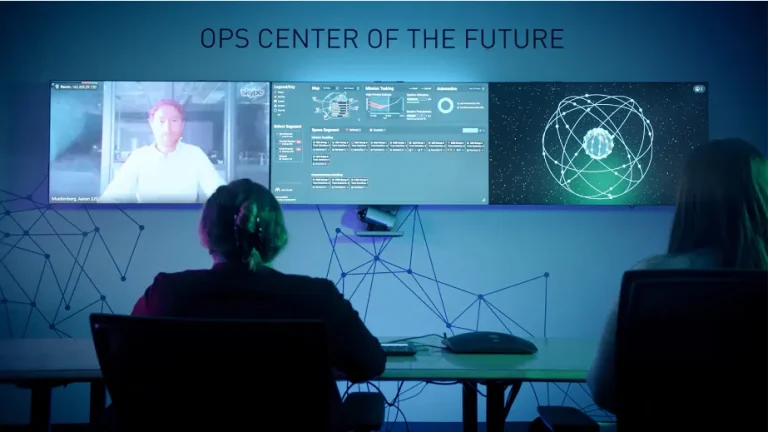
Lockheed Martin will heavily rely on AI and machine learning in its new facility.
Lockheed Martin has announced the creation of a “Future Operations Center,” an innovative facility designed to make it easier for the company to manage its ever-growing constellations of Earth-orbiting satellites.
The facility, located near Denver, is a major innovation for satellite operation, according to company representatives. It can handle multiple mission spaces at once through a secure, web-enabled cloud framework.
These software platforms have already been used on over 50 spacecraft missions, ranging from government contract work to research and commercial ventures. Over 50 spacecraft missions, ranging from government contracts to retail and research experiences, have been completed using these software platforms.
Maria Demaree is vice president and general manager of Lockheed Martin Space’s National Security Space division. She praised the facility’s advanced technology in a Lockheed press release. Demaree stated that the next-generation AI capabilities, automation, and cloud features of the Operations Center of the Future allow operators to be closer to the mission, no matter where they are physically located. Remote operators can receive timely alerts on satellite operations and securely log in from anywhere to make fast, smart decisions.
This capability was demonstrated earlier this year when Lockheed’s In-space Upgrade Satellite System Demonstrator was successfully launched. It was intended to show the potential of small satellites for maintaining infrastructure in space or even enhancing it with new functionality after deployment.
Lockheed claims that the combination of AI, automation, and machine learning at the center will allow it to manage the rapid increase in the number of satellite constellations deployed into an already crowded lower Earth orbit.
The company praised the facility for its lean operations team, thanks to a flexible framework of software that can be refactored to meet different mission types and requirements.
It’s unclear how well it will perform, but there are plenty of reasons to be skeptical at this stage. Many companies have big AI plans, but so far, they’ve failed to prove their utility in the real world.
Lockheed Martin could have created a system that manages the complex trajectories for tens of thousands of satellites with little human intervention. Mission Control could also be a sophisticated version of ChatGPT, making up stuff as it goes, just with satellites flying in streams of junk space.
We’ll find out soon enough. Lockheed’s Operations Center of the Future will play a major role in directing the next space missions of the company, including Pony Express 2 and TacSat.