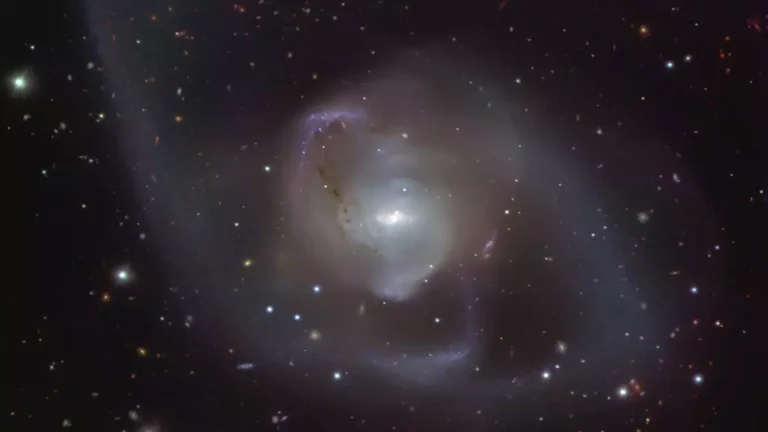
The Very Large Telescope of the European Southern Observatory in Paranal (Chile) has captured a stunning image of a collision of two galaxies, which led to a giant universe, NGC 7727. Around a billion years ago, the merger began.
Galaxies collide, not individual stars. The distances between galaxies are large in comparison to their size. Gravity creates a tidal force that drastically changes the appearance of nearby galaxies.
This image of the Galaxy shows off the consequences of this cosmic bump. As the galaxies merge, the stars and dust are stripped from each other to form the spectacular arms that embrace the universe. These arms are covered with bright spots of blue-purple stars.
Two bright points are also visible at the center of the Galaxy in this picture, another sign of its dramatic history. NGC 7727’s core is made up of two original galactic nuclei. Each body contains a supermassive dark hole. This pair of supermassive dark spots is located about 89 million light years from Earth in the constellation Aquarius. These two black holes are only 1,600 light-years apart and are destined to merge into a black hole even more massive. The two black holes are predicted to join in 250 million years. This is a blink of an eye when viewed from an astronomical perspective. In billions of years, our home galaxy will merge with the Andromeda Galaxy.