In order to predict the behavior of materials, it is necessary first to understand their properties. Imagine you are interested in manipulating or designing new materials to serve a technological purpose, such as electronic or photonic circuits. You will need to be able to grasp the dynamics of structural structures.
Modeling solid crystalline materials, such as metals and ceramics, rocks, and bones, is notoriously difficult. These materials are composed of domains, grains, and defects, and multiple competing forces challenge them. Scientists have developed highly specialized X-rays to model these materials. They’ve gotten down to a resolution of 100 nanometers, which is more than 500 times smaller than a human hair.
But resolution isn’t the only issue to be addressed. Scientists have been unable to track the changes in these materials in greater detail than milliseconds or seconds. Some things in crystals happen quickly, such as when they change their shape or transfer heat. The atoms within the crystals determine how these things happen. They often occur in microseconds–sometimes even pico- or nanoseconds (one trillionth/one billionth of a second, respectively).
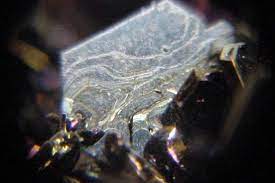
Sound waves traveling through material is another such phenomenon. The sound waves are only present for a fraction of a second. In a recent article published in the journal PNAS, Real-time imaging of acoustic wave in bulk materials using X-ray Microscopy, Danish and American researchers have captured soundwaves traveling through a diamond sample measuring 1 mm.
The crystals were damaged or couldn’t be scanned fast enough. Henning Friis-Poulsen, DTU Physics professor and corresponding author, explains that the new technology is faster and less invasive and can be used for many different crystals. He added:
To achieve imaging at sound speed, it was essential to build a new microscope at the other end of the 3 km “X-ray laser free-electron” (XFEL). You can’t expect to succeed if you aim a 3km long X-ray beam through multiple lenses onto a 1mm sample and hope to hear a soundwave lasting only a million seconds. Before the first data was collected, our hair-thin optical and X-ray laser beams needed to be synchronized with the mm-sized diamond sample. We did it, and these results will inspire an array of new research.
Theodor S. Holstad, co-author of the paper, explains how their approach is applicable to all types of crystalline materials.
With this setup, we are able to investigate a range of ultrafast structure phenomena that were previously beyond the reach of science. Solid-state physics and materials science are all affected by the ability to visualize structural processes at a timescale of less than one microsecond when you are trying to understand meta-materials such as photonic crystals or thermoelectric materials. Or even soft materials like perylene and hybrid perovskites. It may also be helpful in geosciences to test seismic models that describe how sound travels through planetary materials.”
The sound waves were captured with timesteps that are as small as a few picoseconds. These snapshots have been edited to create small films.
The team recorded videos of different types of sound waves traveling and reflecting off of the surface of the crystal.
The images also capture dispersion or the spreading of a wave over time. They also show attenuation.
They also demonstrated that a single pulse of X-rays less than one-thousandths of a microsecond in length was enough to image, opening up the possibility for real-time visualizations on timescales less than microseconds. This is much faster than milliseconds and microseconds, which are currently the limits.
The Villum Experiment funding scheme is aimed specifically at high-risk/high-reward experiments that explore unconventional and groundbreaking new ideas. Professor Henning Friis and Senior Researcher Kristoffer Holdrup led the project. Postdoc Theodor S. Holstad led the project.
Ass., the team of researchers from DTU Physics, have already worked together on another beamtime in the European XFEL. Prof. Leora Dresselhaus Marais used the same method to capture interactions between structural defects and acoustic waves.
Postdoc Theodor S. Holstad has also recently been awarded another Villum grant for his project “Capturing Lightning in Solid-State Materials,” in which he intends to use ultrafast X-ray microscopy in order to capture the electric breakdown of solids.