Nearly a thousand years ago, back in the year 1054, a new star seemingly appeared in the night sky. Outshining all others, including Sirius and even the planets, it was even briefly visible during the day and then faded away, disappearing for centuries. It wasn’t until well after the invention of the telescope that anyone would see the aftermath of that event: when 18th-century astronomers found a remnant of what was a core-collapse supernova explosion lurking in the same region of the sky. Over time, as our astronomical capabilities improved, driven by multi-wavelength capabilities, high-resolution telescopes, and instruments capable of tracking details over long periods, we finally pieced together what was truly occurring.
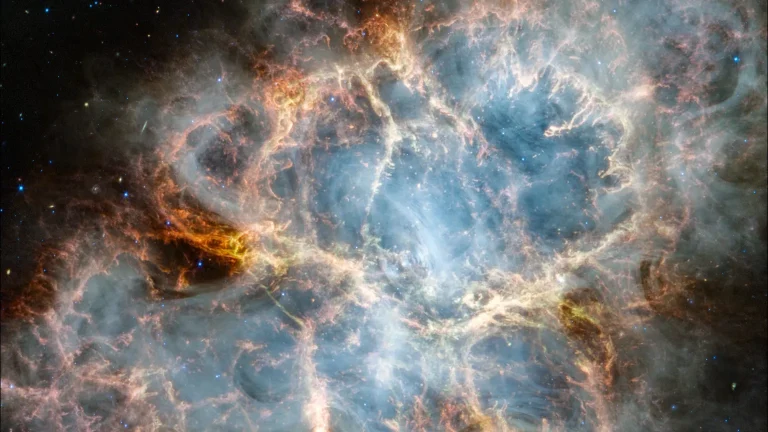
Back in 1054, a once-massive star underwent a core-collapse event, dying in a supernova and leaving a pulsing neutron star behind at its center. The remnant that we see today, known as the Crab Nebula, continues to expand and evolve, spanning an impressive 11 light-years across at present. Previous studies have revealed enormous stores of gaseous material ejected into the interstellar medium: about five solar masses worth. Combined with the mass of the remnant pulsar, however, a mystery remains: it should take at least eight solar masses to trigger a core-collapse supernova, and the material here doesn’t add up.
Could it be JWST to the rescue? With new imagery from its NIRCam and MIRI instruments, we’re getting a superior view of this nebula compared to all the ones that came before, and further details are already appearing. Could JWST solve this cosmic mass mystery? Let’s dive into the details and see! Uncovering the details of the initial explosion required looking back through worldwide records, as no Western/European sources recorded it. The first discovered source came from the Chinese empire, where astronomers recorded what they called a “guest star,” first appearing on July 4, 1054. Contemporaneously, sightings were recorded in Japan and the Middle East, revealing that this star remained visible for around two years before fading away below the naked-eye threshold. In hindsight, this is typical behavior for a core-collapse supernova: swiftly rising to a tremendous peak brightness that’s thousands to millions of times the brightness of the original star, then gradually fading away over months to years.
Then, hundreds of years later, the remnant of this ancient explosion — although the connection wasn’t made until much later — was discovered by John Bevis back in 1731. Of course, back in the early 18th century, astronomers weren’t much interested in these fuzzy smudges that appeared in the sky; they were interested in things that were nearby, like planets, moons, and comets. That’s why Bevis’s discovery went largely unnoticed until 1758 when Halley’s comet was due to return. The comet, previously seen in 1456, 1531, 1607, and 1682, was now due to return, as predicted by Edmond Halley back in 1705.
Although Halley had died back in 1742, astronomer Charles Messier had taken up searching for the comet’s return. While exploring a particular part of the sky, he accidentally noticed this object and first confused it with the vaunted comet before realizing his mistake.
Messier determined not to let these “permanent” objects in the night sky confuse other comet-hunting astronomers and began creating the famous astronomical catalog of things that bears his name: the Messier catalog. This object, now known as the Crab Nebula, became the very first object that Messier would catalog, and it still bears the designation of M1: Messier 1. It’s now been an impressive 265 years since its rediscovery, and this nebula remains a fascinating object of study for a large number of bona fide reasons: more than could fit into a single article. However, some of its remarkable properties include:
- It’s one of the closest core-collapse supernovae to occur in modern human history,
- At only 6,500 light-years away, it’s possible to resolve individual features within it, including gas filaments and wind-driven ejecta,
- We can physically see the nebula itself expanding over time,
- We can determine that its core is powered by a fascinating stellar remnant: a young pulsar or a neutron star that spins around on its axis an impressive 30 times per second.
This object remains a delight to amateurs and professionals alike, as practically anyone with a telescope can find it and view it for themselves. With off-the-shelf equipment, even a dedicated amateur can measure the expansion of this nebula over decade-long timescales.
Today, it’s got a remarkable set of properties to it, which have been revealed through a variety of observations that span the full gamut of electromagnetic wavelengths.
- Back in 1054, this supernova reached a peak brightness that saw it shine as bright as 400 million Suns, all combined.
- Now, 969 years after it first detonated, the supernova remnant spans a full 11 light-years across, from end-to-end, with the outskirts still expanding at 0.5% of light-speed: around 1500 km/s.
- X-ray observations, such as those taken by NASA’s Chandra X-ray Observatory, are the best at revealing the hot gases and plasmas created by the central pulsar, including how those features change over time in a movie-like format.
- And it’s the innermost regions around the pulsar itself, where relativistic, rapidly accelerating matter is present, that generate winds that transport material and energy to the outer portions of the nebula, driven largely by electrons moving near the speed of light.
The visually stunning filaments in the outer regions, observable in Hubble (visible light) images, only change and grow relatively slowly, as the shocks and instabilities in that region are rather insensitive to short-term changes in the nebula’s overall behavior.