Scientists have known for a long time that Mercury is shrinking. Mercury is the closest planet to the Sun, and yet its interior is cooling as heat escapes. The rock (and metal within it) that is its composition must have shrunk in volume.
Unknown is how much the earth is shrinking and for how long. Our new paper in Nature Geoscience, offers new insights.
Mercury’s interior shrinking means that its crust (surface) is covering less and less space. The planet responds by developing “thrust-faults,” where one area of terrain is pushed over another (see below). Mercury’s interior shrinks due to thermal contraction, just like wrinkles on an apple.
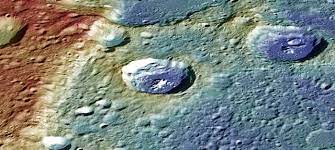
Mariner 10’s 1974 mission sent pictures showing kilometre-high scarps, or ramp-like slopes, snaking across the terrain. Messenger, the orbiter that orbited Mercury from 2011 to 2015, revealed many more “lobate ridges” in every part of the world.
It was possible to determine from these observations that gentle dipping geological flaws known as thrusts approach the surface beneath each Scarp. They are a reaction to Mercury’s radius having shrunk by approximately 7km.
When did this happen exactly? Counting the number of impact craters is a common way to determine the age of Mercury. The more holes, the older the surface. This method is difficult, however, as the rate at which impacts produced craters in the past was much higher.
Mercury’s scarps are clearly older, as they have a number of younger craters superimposed on them.
What was the last time that Scarp moved?
Mercury’s scarps, according to the majority of scientists, are about 3 billion years old. Are they all that old? Did the older ones stop moving long ago, or are they still moving today?
It is not reasonable to expect that each thrust fault has only moved once. The Tohoku earthquake, which was the largest earthquake in recent history and caused the Fukushima catastrophe, was measured at magnitude 9. This earthquake occurred off the coast of Japan in 2011, causing a jump of 20 meters over a distance of 100km along the thrust fault.
Mercury’s largest “earthquakes,” if they exist, are likely smaller. Mercury’s typical Scarp can measure 2-3km in total shortening. To achieve this, it would have taken hundreds of “earthquakes” of magnitude nine or millions of smaller events spread over billions of years.
Mercury’s thermal expansion is not yet complete, although it should be slowing.
Cracking up
Evidence has been scarce until now. Our team discovered unambiguous evidence that scarps continue to move even though they began billions of years ago.
Ben Man, a PhD student from the Open University, UK, noticed small fractures on some scarps’ stretched surfaces. He identified them as “grabens,” a geological term for a strip of land dropped between parallel faults.
It usually happens when the crust has been stretched. Stretching on Mercury may be surprising, as the crust is generally being compressed. However, Man realized that grabens could occur when a thrust piece of crust was bent while it was pushed across the adjacent terrain. You may see cracks in the toast if you turn it.
The grabens measure less than 100 meters in depth and less than 1 km wide. These small features are much younger than ancient structures on which they rest, or they would already have been wiped out by impacts that tossed material across the surface. This process is called ” Impact Gardening“.
We calculated the age of most grabens based on the blurring rate caused by impact gardening. This is less than 300 million years. This implies that the most recent movement happened “recently.”
Moon Lessons
Moon also cooled down and contracted. The scarps on the Moon are smaller and less impressive than those found on Mercury. However, we do know that some of them are still active.
A recent reanalysis shows that the moonquakes cluster close to the lobate scarps.
The most detailed images from the orbit of the Moon reveal tracks left by boulders that bounced down scarps, probably after being displaced by moonquakes. These boulder tracks are much smaller than Mercury’s Grabens. The same logic also applies: They would be erased after a few million years and so must be relatively young.
Mercury will not be receiving any seismic data from BepiColombo, as it won’t land. The most detailed images could reveal additional evidence of recent earthquakes, such as boulder tracks. I’m looking forward to learning more.