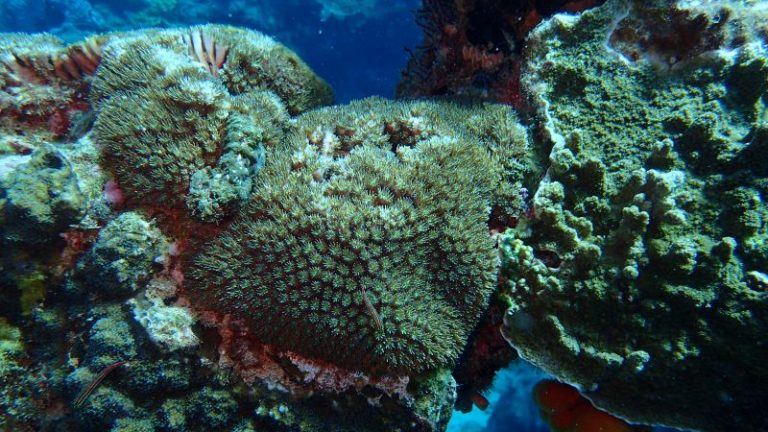
New research by the Australian Institute of Marine Science and the University of Melbourne indicates that adult fragments of the coral Galaxea facicularsis are better able to tolerate bleaching and can recover faster when treated with heat-evolved cells of algae called symbionts.
The study published in Global Change Biology used symbionts, the tiny cells of algal that live in coral tissue, to support growth, which was boosted in the laboratory by exposure to high temperatures for ten years. The heat-evolved bacteria were then given to coral fragments that had been chemically bleached.
Researchers found that the symbionts could maintain a symbiosis for up to two years with adult corals, which promoted faster recovery after bleaching. They also increased the corals’ heat tolerance and growth without affecting the corals negatively.
The lead author, Dr Wing Yan Chan of AIMS and University of Melbourne, said that the new findings suggested heat-evolved algae symbionts could be a valuable resource for coral restoration and could also be used in other life stages and coral species.
The symbionts remained in the corals for two years after they were inoculated. This suggests long-term stability and possible benefits for coral heat tolerance, Dr. Chan explained.
“Strategies that increase coral heat tolerance will buy reefs time, as they are threatened by the climate change-driven heatwaves in the oceans, which can cause coral bleaching or even death. This symbiosis is stable over time, which gives hope that these heat-evolved cells will continue to benefit their coral hosts.
Senior author Professor Madeleine van Oppen, from AIMS and the University of Melbourne, said that earlier work by her group showed the benefits of exposing larvae and juveniles of corals to heat-evolved symbionts.
Professor van Oppen stated, “These new discoveries on adult corals close the circle” and show the benefits are still present in adulthood.
This is one of many approaches referred to by the term ‘assisted evolutionary.’ It involves active interventions that accelerate naturally occurring evolution processes.
Dr Line Bay, Research Program Director at AIMS’ Reef Restoration and Adaptation Program, said that the research was a significant step in improving heat tolerance among corals.
Dr. Bay stated that “this study is part the extensive work AIMS and our partners are doing to protect corals against climate change.”
To give coral reefs a better chance of survival, we must reduce emissions, manage coral reef systems well, and develop interventions such as heat-evolved parasites that can boost climate tolerance and reef resilience.
Research:
- The study found that heat-evolved bacteria did not affect the coral’s growth ability. This is in contrast to previous studies on Great Barrier Reef corals, which showed naturally heat-tolerant symbionts can enhance coral heat resistance, but this comes at a price to its growth.
- Next, controlled field trials will be conducted to test whether the intervention can work in the field with multiple coral types and at scale.
- This research was conducted in collaboration with AIMS, the University of Melbourne Monash Institute of Pharmaceutical Sciences, and the Melbourne Centre for Nanofabrication.
- The Australian Research Council funded the research, as did the Paul G. Allen Family Foundation and RRAP. A partnership between the Australian Government Reef Trust and Great Barrier Reef Foundation finances RRAPtion.