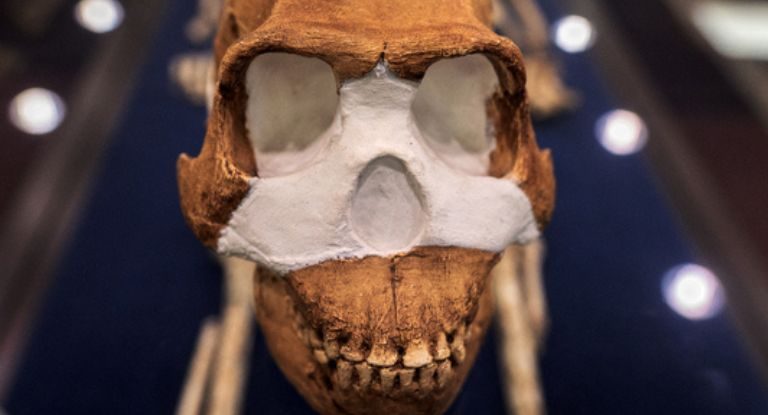
Paleontologists from South Africa have discovered the oldest burial site known in the world. It contains remains of an ancient distant relative, thought to be incapable of complex behavior.
Researchers led by renowned paleoanthropologist Lee Berger announced in June that they had found several specimens of Homo naledi – a stone age tree-climbing hominid – buried 30 meters (100 feet) underground in a system of caves within the Cradle of Humankind UNESCO World Heritage Site near Johannesburg.
The scientists published a series of preprints in eLife.
The findings are a challenge to the current understanding of evolution. It is generally believed that the evolution of larger brains enabled the performance of complex “meaning-making” tasks such as burying dead.
The oldest burials, which were found in Africa and the Middle East, contained remains of Homo Sapiens and dated back around 100,000 years.
The ones found in South Africa by Berger and his colleagues, who have made controversial announcements before, date to at least 200,000 BC.
They also belong to Homo Naledi, a primitive species that was at the crossroads of apes and modern humans and had brains the size and shape of an orange and stood around 1.5 meters (5 feet) tall.
The species Berger discovered had already shattered the idea that evolution was a straight line. They had curved toes and fingers, hands for holding tools, and feet designed for walking.
Researchers say that the holes contain at least five bodies. They were dug deliberately and then covered with dirt to conceal them.
Researchers said that the findings “show mortuary practices weren’t limited to H. Sapiens or other hominins large in brain size.”
They added that the burial site was not the only evidence that Homo Naledi could have displayed complex cognitive and emotional behavior.
Brain size
On the smoothed surface of a nearby cave pillar, there were engravings in geometrical shapes. One was a “rough #hashtag figure.”
Berger, in an interview with AFP, said: “It would seem that humans are not the only ones who have developed symbolic practices. They may not even be the inventors of such behaviors.”
These statements will likely raise some eyebrows in the paleontology world, where the 57-year-old has been accused of lacking scientific rigor.
In 2015, Berger’s earlier discoveries, which National Geographic had supported, were criticized when he first suggested that Homo Naledi could do more than its size would suggest.
Scientists at the time could not handle that. He said, “We think it is all connected to this big brain.”
We’re about to tell the world this is not true.
Agustin Agustin Fuentes is a professor at Princeton University and co-author of the study.
Carol Ward, a University of Missouri anthropologist who was not involved in the study, stated that “these findings would have a considerable impact if they were confirmed.”
She told AFP, “I am looking forward to seeing how the dispositions of remains exclude other possible explanations besides intentional burial and the results after they have been vetted by peer review.”
Ward pointed out also that the paper admitted that it couldn’t rule out the possibility that later hominins could have created markings on walls.